
18.7% of the children with high screen time displayed a motor delay, whereas 13.3% of the children with low screen time displayed a fine motor delay. However, this difference was not significant by itself. The children who had more than two hours of daily screen time were more than twice as likely to show a developmental delay in at least one domain. This was true after adjusting for age, sex and mother’s education.
If you give five three-year-old children a crayon, you’ll get five different ways of holding it. One child holds it as if it were a fist. Another drops it every ten seconds. A third is already drawing circles and smiling in the way that a child does when he or she has just invented art. Fine motor skill is not a matter of chance. It is simply a matter of motor skill.
For many years I have been observing this situation in classrooms, and the following point is one that is never made to new parents: it’s not mainly a matter of talent but rather of practice and repetition as well as the kind of mess that is appropriate. Nowadays I include a great deal of that experience from the classroom in the activity guides that I write for TheLittleScholar.
People ask me the same question in all sorts of ways: is my child falling behind? am I doing enough? what really works? The straightforward reply is that motor activities for preschoolers needn’t be complicated. Most of them are already sitting in the drawer of your kitchen at this moment.
This guide covers what fine motor skills actually are, why they matter more than most parents assume, and ten activities worth trying this week. We’ll also get into warning signs worth watching and when normal slow progress stops being normal.
What Are Fine Motor Skills?
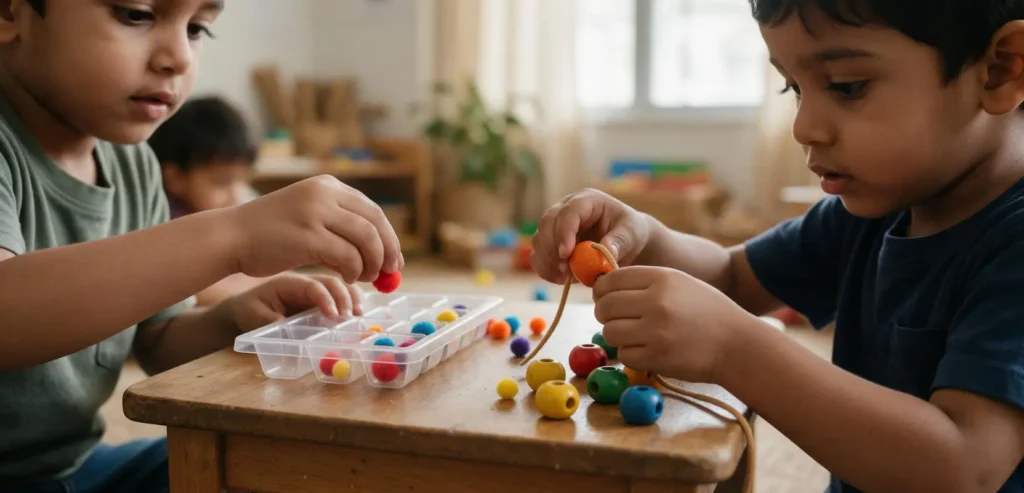
Fine motor skills are the careful moves that you do with your hands, fingers, and wrists. Running and climbing stairs two at a time are not motor skills; they belong to gross motor territory. Fine motor skills allow a child to pick up a grain of rice, turn a doorknob or hold a spoon without throwing dal across the table.
Occupational therapists usually break it into a few pieces:
- Pincer grasp means using the thumb and index finger to pick up things.
- Hand-eye coordination is when the eyes give instructions to the hands and the hands follow them correctly.
- Wrist stability refers to having a wrist that stays steady and doesn’t shake during an activity.
- Bilateral coordination happens when both hands work together. One hand holds something still while the other hand does the task.
No child wakes up with this fully wired. It builds slowly. It starts with the reflexive grasp babies show in their first months, and it keeps refining right through the preschool years, until that pincer grasp is controlled enough to hold a pencil the “correct” way.
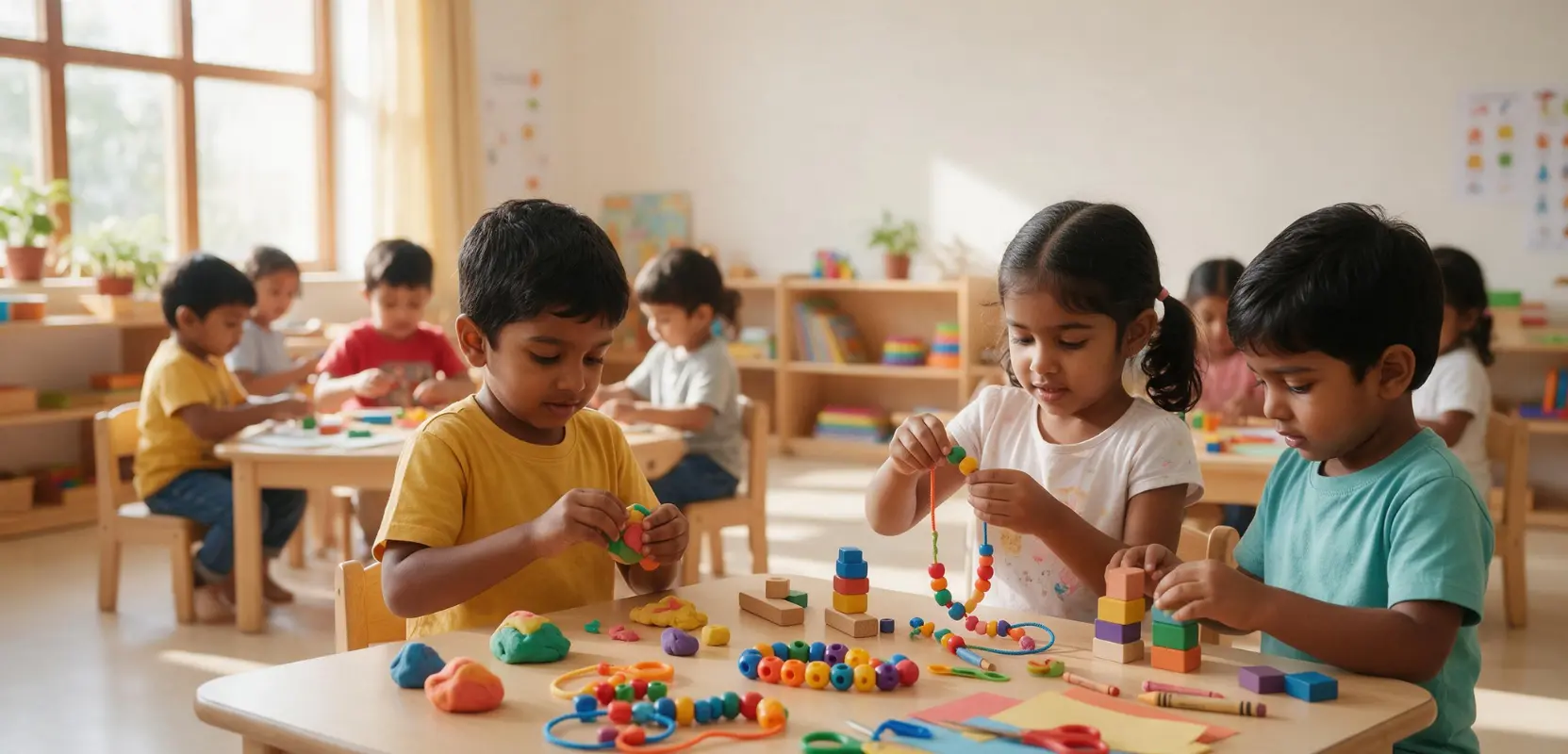
Most of this growth comes from playing rather than from formal lessons. A three-year-old squishing dough or putting blocks on top of each other is exercising the muscles that she will use to write her name two years later. She has no idea about it yet.
I have seen children solve a puzzle by using brute force rather than by guiding their fingers, forcing the pieces in anywhere they will fit. That isn’t laziness; it simply means that their hands have not yet been trained. If they have a few weeks of appropriate play, the difference will be clear. A Rough Guide by Age
A Rough Guide by Age
| Age | What’s Typical |
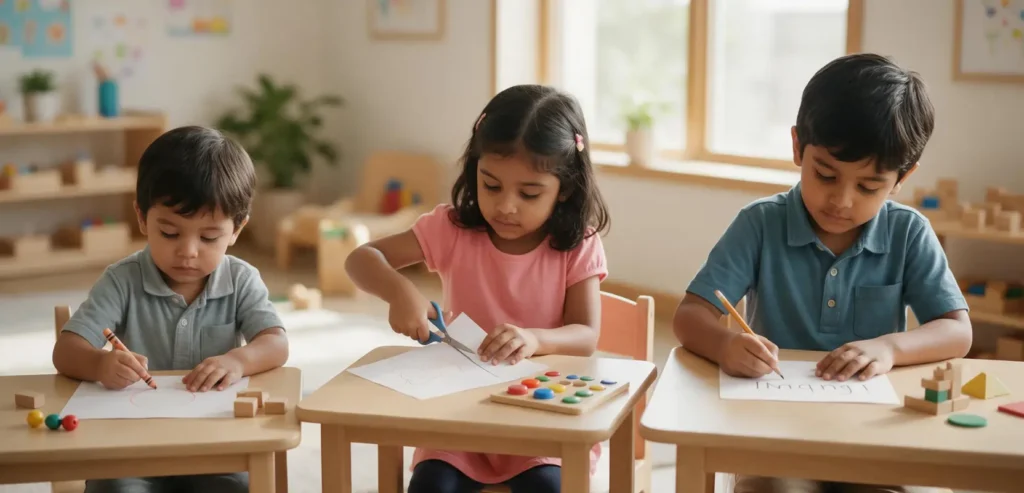
| 3 years | Holds a crayon with thumb and fingers, copies a circle, threads large beads, stacks 8 to 10 blocks, snips paper with scissors. |
| 4 years | Copies basic shapes, draws a person with a few parts, cuts along a straight line, fastens large buttons, pulls a zipper independently. |
| 5 years | Cuts along a line continuously, copies a square or cross, writes their name, manages most fasteners, builds detailed block structures. |
Treat this as a map, not a deadline. Kids wander off the path constantly. Some catch up in a week. Some take months. Both are fine.
Why Fine Motor Skills Matter for Preschoolers
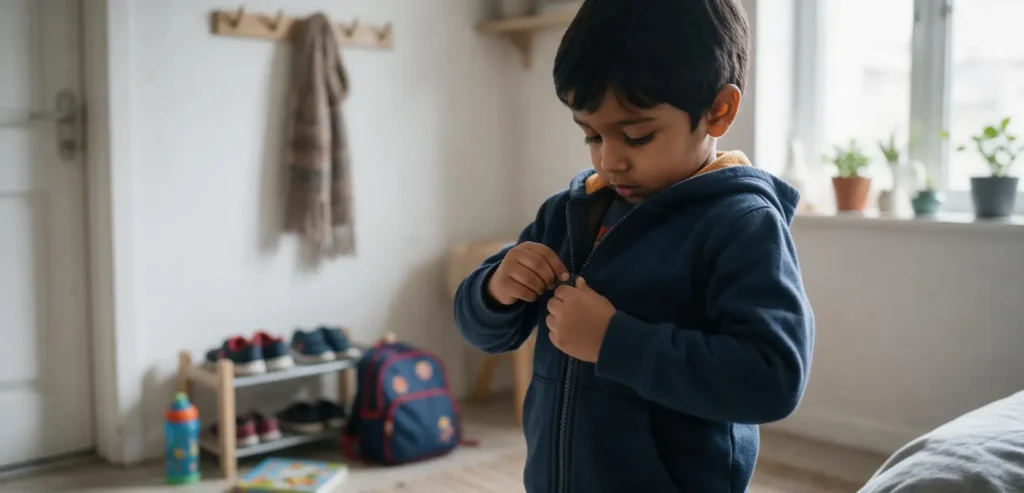
People think that all this has to do with handwriting, but it doesn’t, not at all. Strong motor skills for preschoolers are evident in a number of situations: when having breakfast, when dealing with the shoe rack, and when taking a bath.
Buttoning a shirt. Zipping a jacket. Using a spoon without help. Turning a book page one at a time instead of three. These are fine motor tasks, every one of them. A child struggling here feels it long before any teacher clocks a shaky pencil grip.
There’s also the matter of school. Children who have decent hand strength when they enter kindergarten find it easier to adapt. Activities such as colouring within the lines and cutting out shapes, and later on forming letters, do not seem impossible to them. On the other hand, for a child who lacks this basic foundation, the physical act of writing is actually exhausting, even if they know exactly what they want to say.
But it’s not only physical. Puzzles, threading, and sorting tiny objects – these build patience too. Focus. Problem-solving. A kid wrestling with a stubborn puzzle piece is practising frustration tolerance just as much as finger control. That’s the part most parents miss.
And look, in a world of tablets and touchscreens, kids get fewer natural chances to practise this stuff. Swiping a screen takes almost no hand effort. Threading a bead does. Squeezing a stiff clothespin open does. So the practice has to be intentional now, in a way it wasn’t a generation ago.
There’s a confidence piece too. A child who can fasten his shirt or fill his own glass of water feels a little more able and a little less needing someone standing close by. That sense often flows into everything he does that day.
10 Best Fine Motor Activities for Preschoolers
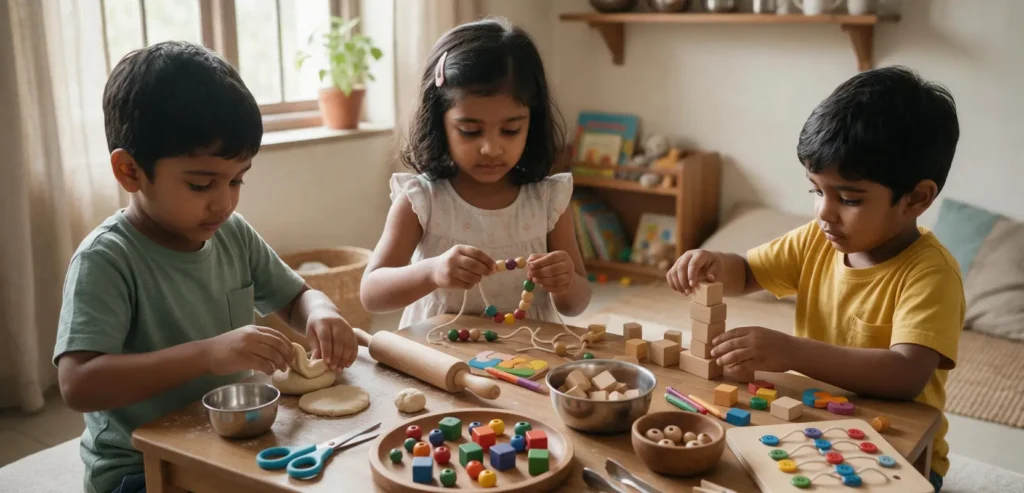
None of this needs fancy toys. Most of it is already sitting in your house. And that’s kind of the point; activities you can repeat daily without a special trip to the store are the ones that actually get repeated.
| SN | Activity | What It Builds | Simple Setup |
| 1 | Dough play (atta or store-bought playdough) | Hand strength, pincer grip | Roll, pinch, and flatten small balls or “rotis”. |
| 2 | Threading beads or dry macaroni | Hand-eye coordination, pincer grasp | String onto a shoelace or thick thread. |
| 3 | Building block towers | Bilateral coordination, spatial planning | Stack high, knock down, repeat. |
| 4 | Cutting with child-safe scissors | Hand strength, bilateral coordination | Straight lines first, then simple shapes |
| 5 | Pouring and transferring | Wrist control, hand-eye coordination | Pour water or dry rice between two katoris. |
| 6 | Picking up objects with tongs or tweezers | Pincer grasp, finger isolation | Move cotton balls or dry chana between bowls. |
| 7 | Finger painting and crayon drawing | Grasp development, hand-eye coordination | Keep it loose; scribbling counts. |
| 8 | Simple puzzles and peg boards | Finger control, problem-solving | Start with 4 to 6 large pieces |
| 9 | Buttoning, zipping, and lacing | Self-care fine motor skills | Practise on an old shirt, not while rushing out the door. |
| 10 | Clothespin or clip activities | Pincer grasp, hand strength | Clip around the edge of a box or paper plate. |
A couple of these deserve extra attention. Dough play works because it hits several muscle groups at once. Rolling uses the whole hand. Pinching isolates the fingers. Flattening builds the wrist. And tongs? Tongs are underrated. The tool itself forces the correct finger position, so a kid can’t really fake their way through it.
Easy Fine Motor Activities to Try at Home
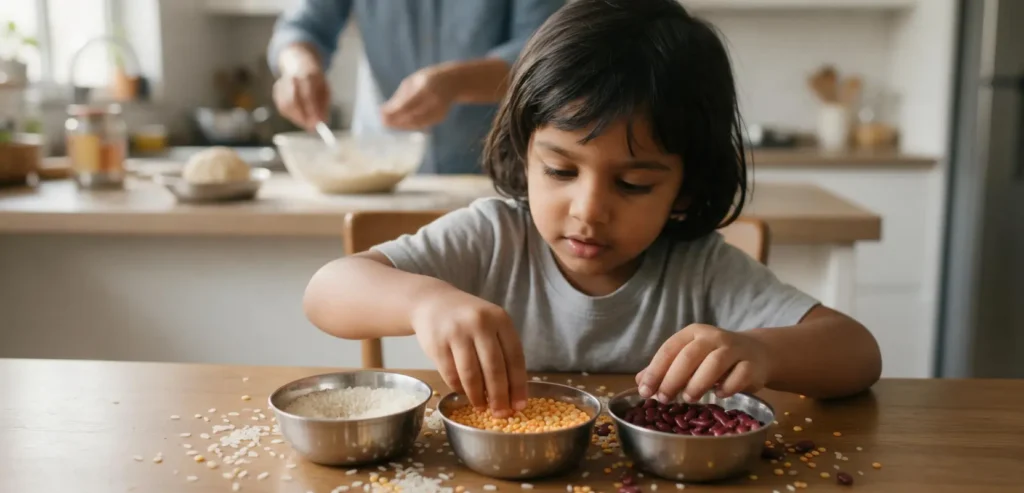
If that list feels like too much planning, here’s the lazy version. Things you can hand a child in under a minute, using stuff already lying around most Indian kitchens.
- Sort dal, rice or rajma by type into bowls.
- Hand over a spice tin; let them screw and unscrew the lid.
- Give them a ball of roti dough to knead while you cook.
- Let them tear paper into strips for a craft; tearing builds hand strength too.
- Have them pick up tamarind seeds or buttons and drop one into each slot of an ice tray.
- Let them help set the table, carrying spoons and small bowls.
- Hand them a spray bottle of water to “clean” a window or table.
- Let them stir batter under supervision; nothing fancy, just a spoon and a bowl.
None of it needs to feel like a lesson. Honestly it should not. Weave a lesson into cooking, tidying and getting dressed. That tends to work better than sitting a child down for an official lesson time. Kids can smell a lesson coming from a mile away, and most of them run in the direction.
Signs of Fine Motor Delay in Preschoolers
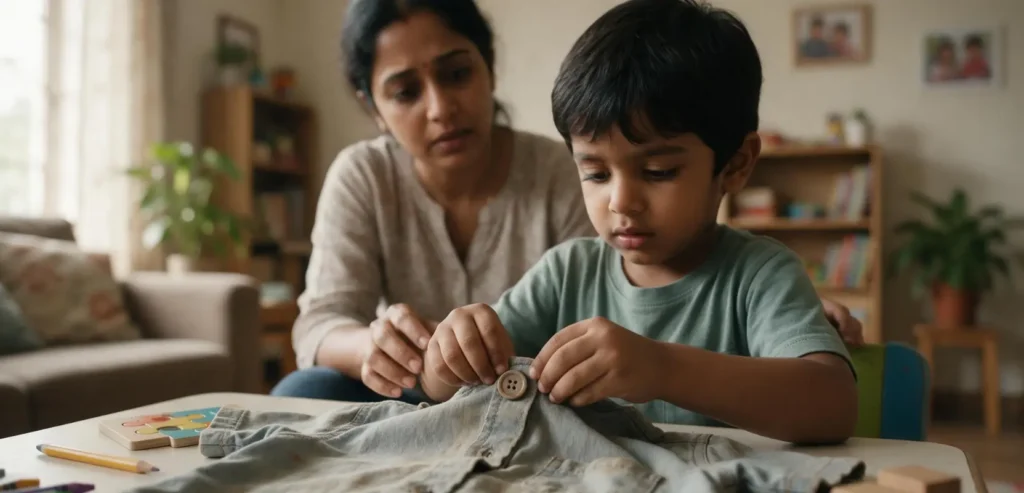
Children all develop at their own speed. A single milestone being missed isn’t significant on its own, but a number of patterns are worth observing, particularly when two or more of them occur at the same time.
- Consistently avoids or resists colouring, drawing, or cutting.
- An awkward, tense, or inconsistent pencil grip well past age 4.
- Switching hands often while eating or colouring instead of settling into one.
- Real trouble fastening buttons or managing a zipper long after peers manage it.
- Struggling to stack blocks or finish simple puzzles.
- Dropping small objects often or tiring quickly during hand-focused tasks.
- Avoiding self-feeding with a spoon or spilling far more than expected past the toddler years.
If you are seeing several of these or they have been going on for months with no change, bring it up with your paediatrician. Do not panic. Just ask. The paediatrician can look at your child. If it is needed, send you to an occupational therapist. Early support tends to work. Young hands and young brains can adjust quickly when they get the kind of practice.
I understand it is tempting to wait and hope that a child will develop a skill on their own. Sometimes that does happen. There is no real risk in asking early, and there can be a real cost to waiting too long.
Tips to Boost Fine Motor Skills in Kids
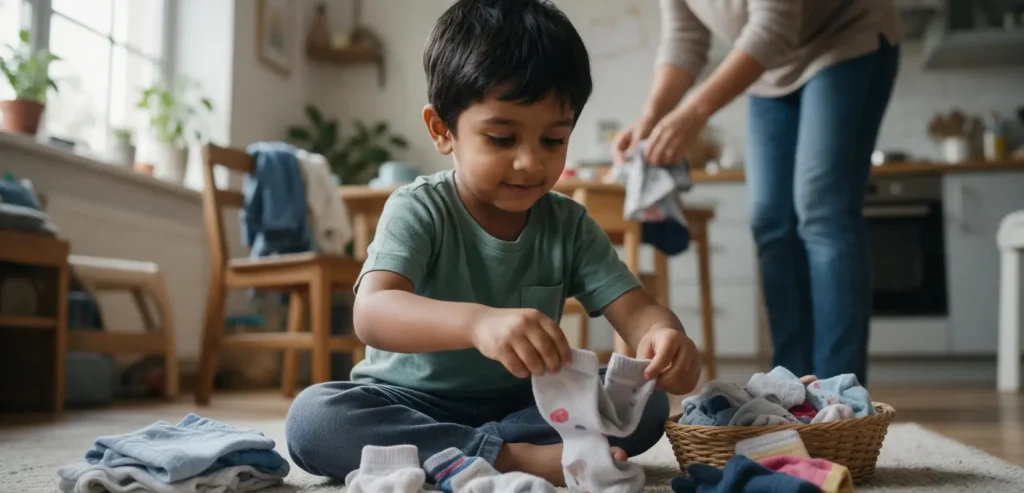
- Follow what the child already likes. Making them do something they do not like never works.
- Keep it short. Ten or fifteen minutes is enough for a preschooler’s attention span.
- Let them have some difficulty before helping. That difficulty is usually where the learning takes place.
- Change the types of activities. Squeezing, pinching, cutting and pouring all help with something a little
- Make chores into learning opportunities. Sorting laundry, stirring batter, carrying cutlery – all of it is practice.
- Keep a basket with two or three choices nearby so practice can happen during short five-minute moments.
- Tell them they did a job, not just about how things look. That is what makes a kid want to try.
Building motor skills for preschoolers isn’t about a strict routine, not really. It’s about handing small hands more chances to work through an ordinary day. That’s the thinking I try to bring into the activity ideas I write for TheLittleScholar, small, low-pressure steps that fit into a day that’s already full.
FAQs
I often hear parents ask this question. Many of them think motor activities are for preschoolers. I tell them you can start motor activities earlier. Even a two‑year‑old who squeezes playdough is practising motor skills. There is no need to wait until preschool. Begin with motor activities. Let it be messy. Keep the tasks small. Then build on what the child learns.
Not at all. Some children just prefer building with blocks or pouring water over drawing. That’s okay. The real concern isn’t one activity. It’s if they avoid all motor tasks, like buttoning, using scissors or holding a spoon. A single preference isn’t a problem. If they refuse, most small-hand tasks that might be worth looking into.
It takes three to four weeks of short, regular practice. Not one long session, on a Sunday. The key is consistency. Do a bit every day. It’s not exciting. It’s what makes a difference. Stick with it. That’s how progress happens.