
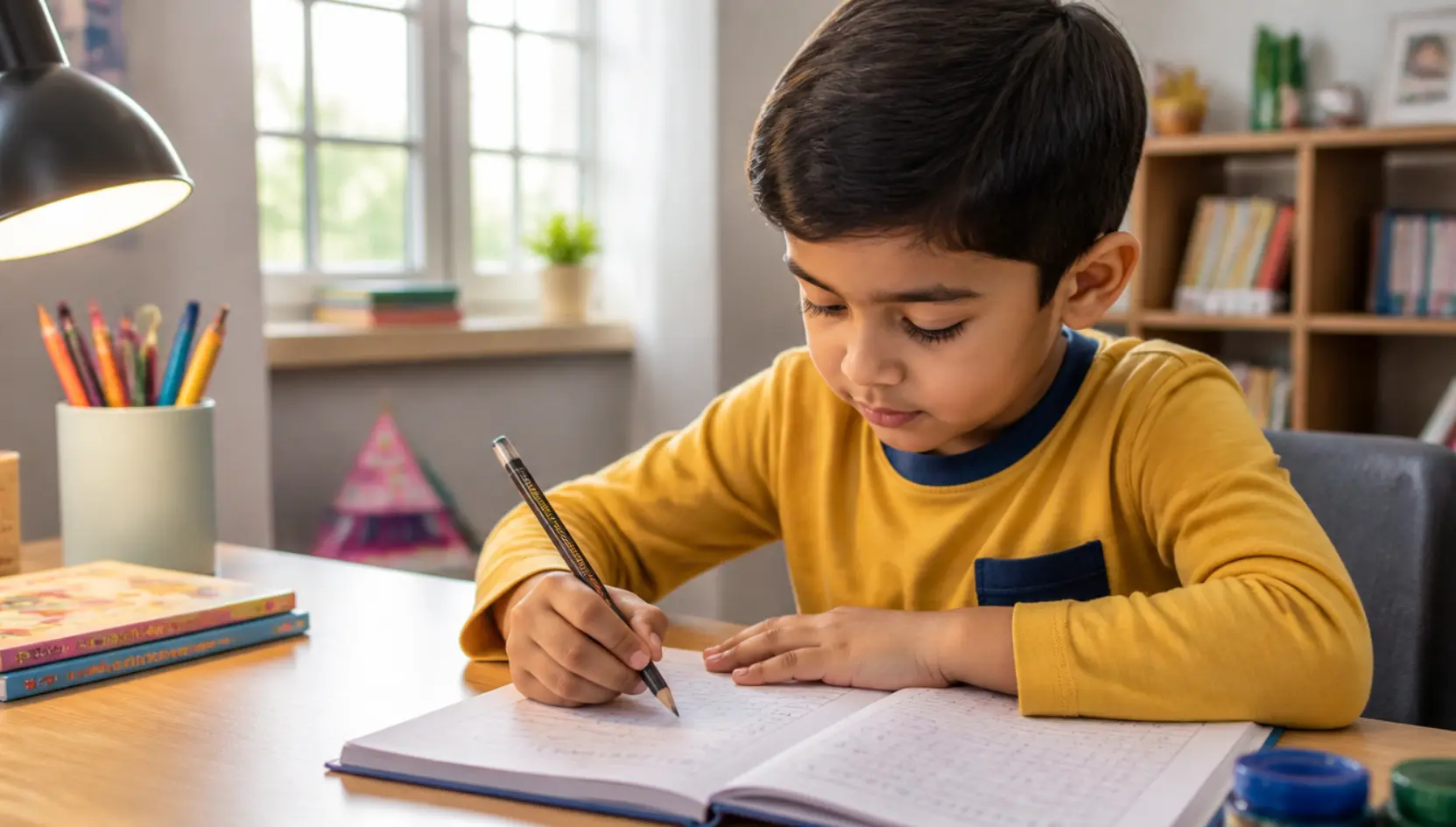
Tablets are everywhere. But does putting pen to paper still matter? It does. Trust me. The reality is, handwriting physically wires a growing brain. It builds memory, spelling, and confidence in ways a keyboard simply cannot.
But it can be brutal. Hand cramps. Torn paper. Tears. I have sat with countless parents feeling completely helpless over their kid’s messy writing. So, take a breath.
Here is the kicker. It doesn’t have to be a fight. Here are six classroom-tested strategies that actually work.
1. Master the Correct Pencil Grip
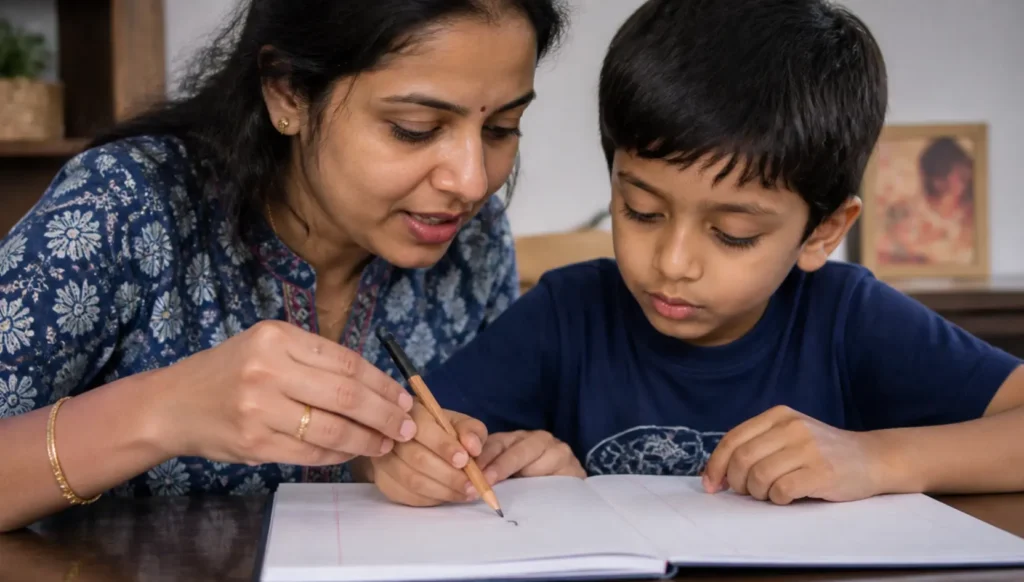
The whole process begins the second a child picks up a pencil. A poor grip is the number one cause of messy handwriting and physical fatigue. The reality is, when a student holds a pencil awkwardly, they rely on the large, clumsy muscles of their wrist and arm. They should be using the small, precise muscles of their fingers. It is tiring. It hurts. And it slows them down.
So, if you really want to improve handwriting for kids, we have to teach the dynamic tripod grasp.
In this ideal grip, the pencil rests comfortably between the pad of the thumb and the index finger. The middle finger acts as a little resting shelf underneath. The ring and pinky fingers are tucked gently into the palm. I always teach the pinch and flip method. Have your child place the pencil on the table with the tip pointing toward them. Ask them to pinch the painted part of the pencil near the tip with their thumb and index finger. Then, have them flip the pencil over so the eraser rests in the web space between their thumb and hand. It works like magic.
But please watch out for over-gripping. Kids with a poor grip often press down way too hard. This causes cramps. It tears the paper. Teach them to hold the pencil like a fragile little bird. Hold it tight enough so it does not fly away, but loose enough so it does not get hurt. Sometimes I give my beginners short golf pencils. Because the pencil is so tiny, there simply is not enough room for all five fingers to grasp it. It naturally forces the child into a proper tripod grip without me saying a single word.
2. Develop Fine Motor Skills
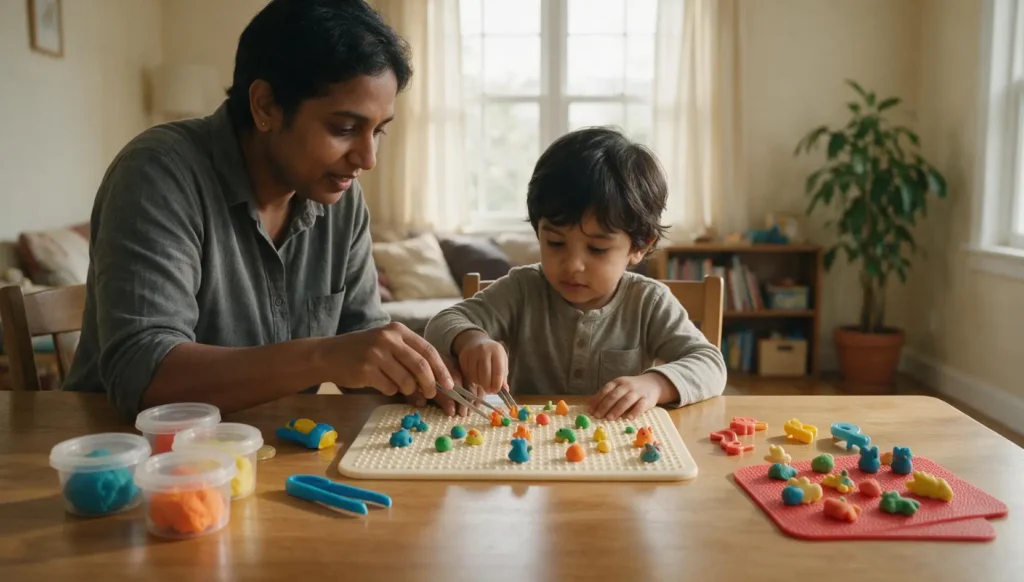
Handwriting does not start on paper. The journey to legible letters begins long before a child ever sits at a desk. It requires well-developed fine motor skills. That means coordinating the small muscles in the hands and fingers. When parents ask me how to improve handwriting for kids, my first answer is usually to go play.
If a child has weak hand muscles, they will absolutely struggle with pencil control and stamina. Get out the playdough. Kneading, rolling, and pinching clay provide heavy resistance that builds serious hand strength. Have your child roll tiny balls of clay using only their thumb and index finger. This develops their pincer grasp.
Scissor skills are also incredibly important. Cutting out complex shapes requires the hands to work bilaterally. That means both hands are doing different things at the exact same time. It builds the specific web space muscles needed for writing.
You can also use tweezers and tongs. Create a silly game where your child uses tweezers to transfer small items like beads, cotton balls, or dried beans from one bowl to another. Stringing macaroni onto yarn helps develop the precise eye-hand coordination required to write letters clearly on a baseline.
By building these underlying physical skills first, you are setting the necessary groundwork.
3. Choose the Right Writing Tools
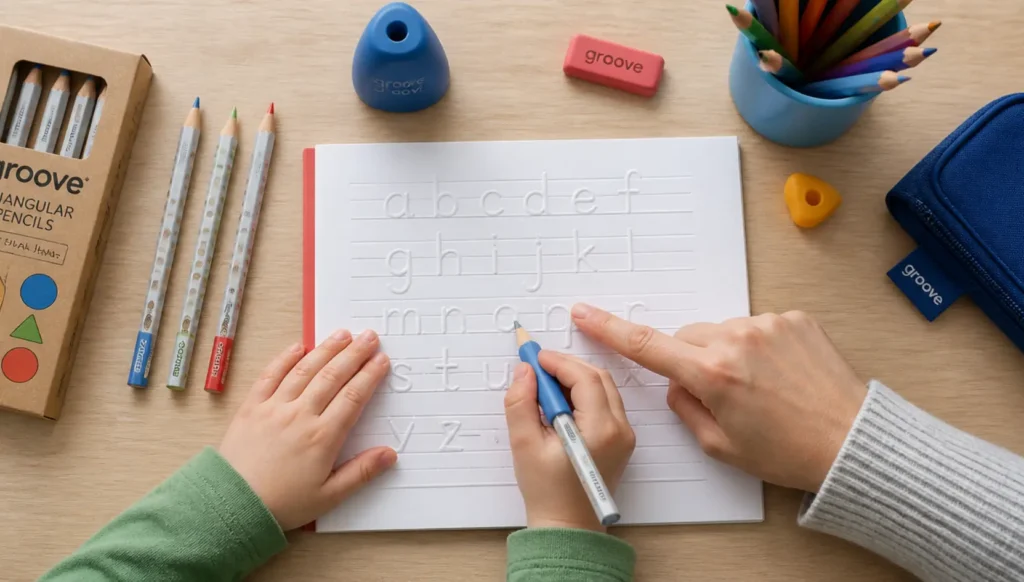
Let’s be honest. Handing a struggling kid a standard round pencil usually makes things worse. Not all tools are created equal. The reality is, swapping out their gear is the fastest way to see a difference.
Round pencils roll and slide right through damp little fingers. In that case, have a try with triangular pencils instead; their flat sides automatically cause the fingers to assume the correct tripod grip. It works like that. And if you are still having difficulty, get ones with silicone grips. The molded indentations show precisely where each finger should go and, over time, gently develop a sense of muscle memory.
Then there is the paper. Standard wide-ruled sheets can be terrifying for beginners. The space is just too vast. But double-lined paper fixes this by giving clear boundaries. Kids quickly see which letters are tall, which stay small, and which drop below the line.
Here is the kicker. For kids who can’t keep words straight, raised-line paper is an absolute game-changer. It provides a physical bump at the baseline. They can actually feel where the pen needs to stop.
4. Improve Sitting Posture
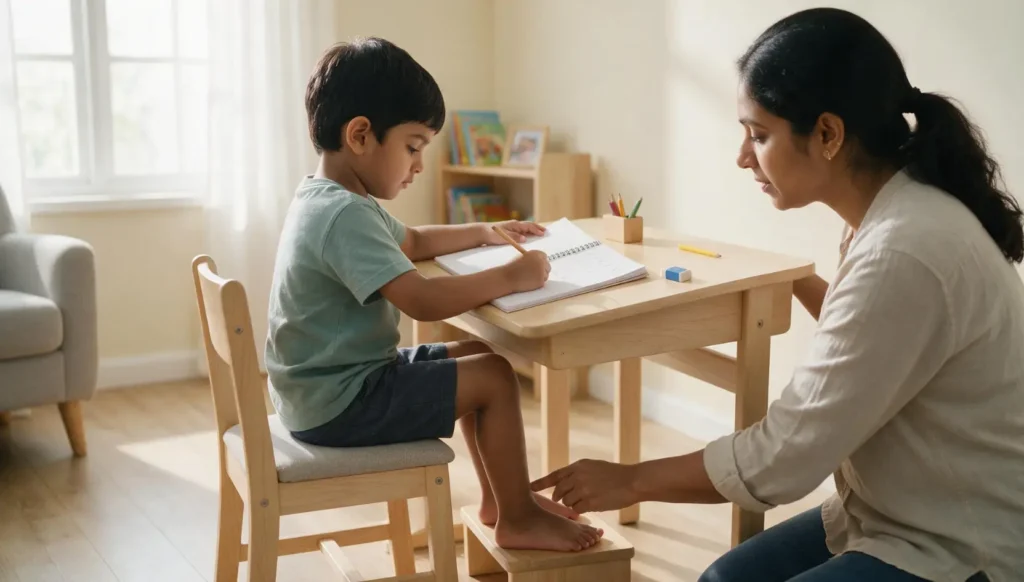
I tell my students this all the time. You cannot write beautifully if you are falling out of your chair.
Before a child can make precise, controlled movements with their fingers, they must have a strong and stable core and shoulder base. If a child is slouching, leaning entirely over their desk, or sitting with their feet dangling in the air, their brain is distracted. It is spending its energy trying to keep them balanced rather than focusing on the writing task.
Addressing ergonomics is a non-negotiable step to improve handwriting for kids.
Follow the 90-90-90 rule for seating. Your child should sit with their hips at a 90-degree angle, knees at a 90-degree angle, and ankles at a 90-degree angle. Their feet must be resting perfectly flat on the floor.
Dangling feet have a bad effect on handwriting, so you should fix that by placing a box or a pile of books under the feet. This will immediately stabilize their center of gravity. The desk should be about two inches above the level of the bent elbows in order to keep the shoulders completely relaxed. And you should stop keeping the paper straight; right-handers should tilt the top right corner upwards and left-handers the top left corner upwards so that they can see their words without having to awkwardly hook their wrists.
Also read: Summer Camp Activities That Go Beyond Just Fun and Games
5. Slow Down for Better Letter Formation
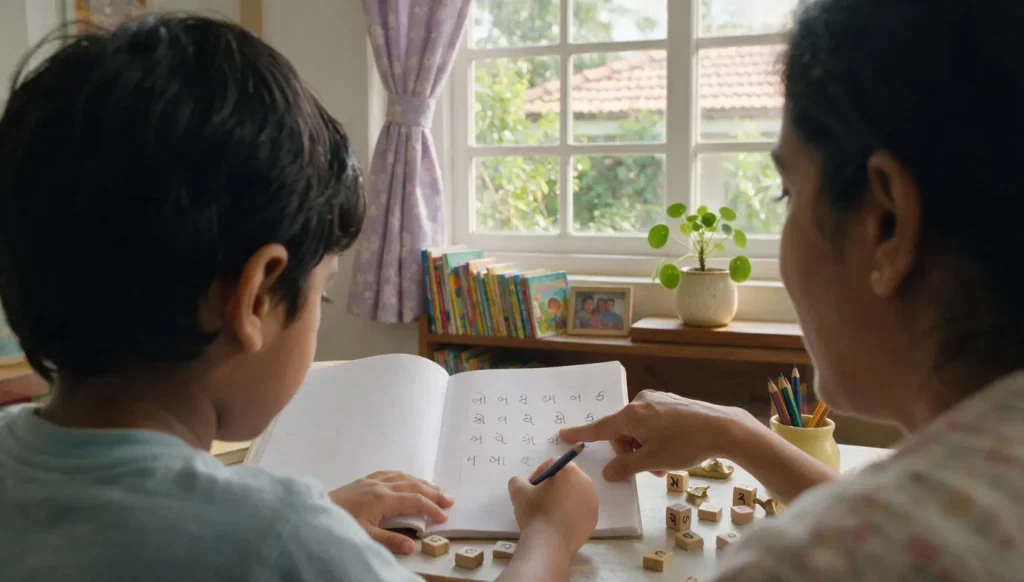
Handwriting is not a race. Yet, children almost always view writing assignments as a sprint to the finish line.
When they rush, their letters become erratic. Spaces disappear. Legibility completely plummets. I constantly emphasize the importance of pacing and correct letter formation to my students. Here is the kicker. A universal rule of handwriting is that letters should be formed from the top down. Never from the bottom up. Writing from the bottom up is incredibly inefficient. It leads to sloppy connections and much slower writing speeds later in life.
Tracing is a popular technique. But it must be done with purpose. Simply tracing shapes blindly does absolutely nothing. A child must know what letter they are tracing and follow the directional arrows to build the correct motor plan in their brain.
Teach your child to evaluate their own work. I like to ask my students to look at their sentence and circle their absolute best letter. This builds visual perception. It builds self-awareness.
Lack of space between words makes sentences impossible to read. Teach your child the finger space rule. Have them place their non-writing index finger on the paper after a word to create a physical barrier before starting the next one. Alternatively, they can place a small object, like a piece of dry pasta, between words.
Simply encouraging them to take a deep breath, slow down, and focus on accuracy over speed will yield massive improvements.
6. Make Daily Practice Fun
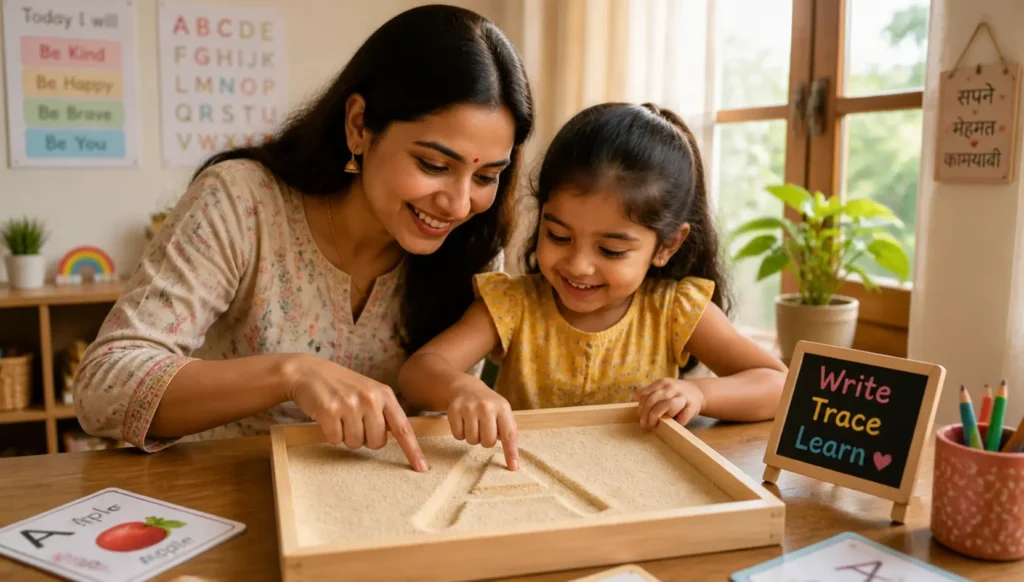
The phrase “handwriting practice” usually brings groans and frustration. If practice feels like boredom and failure, children will naturally resist it. The ultimate secret to improving handwriting for kids is disguising the practice as play. Consistency matters far more than duration. Ten to fifteen minutes of engaging, daily practice is much more effective than forcing a child to sit through a miserable one-hour tracing drill on a Saturday morning.
Remove the pencil entirely sometimes. Have your child practice forming letters by tracing them in a tray filled with shaving cream, kinetic sand, salt, or dry rice. This tactile feedback reinforces the shape of the letter in their mind. Children want to feel that their writing matters. Put them to work. Have them write the family grocery list. Ask them to address postcards to their grandparents or create a daily menu for dinner.
Play word games. Games like Hangman, Tic-Tac-Toe using letters instead of X and O, or simple crosswords require handwriting. But they feel like a game rather than a chore.
Writing on a vertical surface, like a chalkboard or a window with washable markers, is a fantastic trick. It naturally extends the wrist into the optimal writing position and engages the shoulder and core muscles.
Confidence is everything. So lead with positive reinforcement. Point out the beautifully formed letters before gently correcting the mistakes.
It takes time. Be patient.
But celebrate those tiny victories. With consistent daily support, those messy scribbles will absolutely transform into clear, confident handwriting.
FAQs
By the time children reach ten, the issue is generally no longer with the shapes of the letters but rather with consistency, size, spacing, and speed, all of which should remain steady from one line to the next. Therefore, there’s no need for repetitive drills; quick journal entries and a grocery list are far more effective for a child of this age than tracing worksheets.
Cursive isn’t about memorizing shapes; it’s about having a smooth flow. You should begin with simple strokes and connectors before moving on to whole words since the letters have to flow into one another rather than being separate as in printed text. With just a few minutes each day and a loose grip, that flow will begin to come naturally.
Letter tracing. Copying short sentences. Daily formation drills on lined paper. Simple stuff, but it works. And here’s the kicker: one of them sticks without strong hand muscles behind it, so pair the writing practice with clay play or cutting exercises too.