
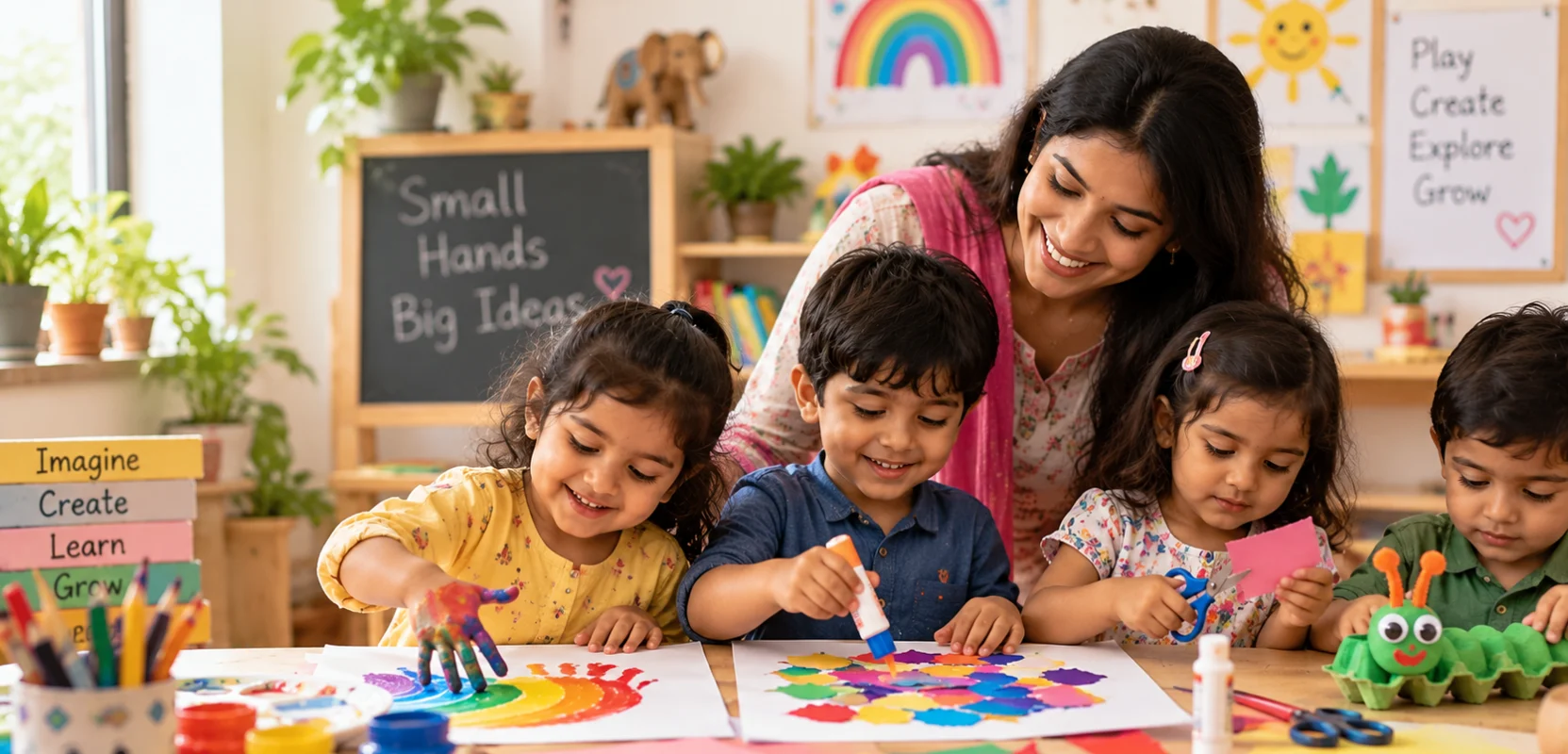
Every time a preschooler snips, colours, glues or plays with clay, he or she is not simply making art. They’re also developing the tiny muscles in their hands they’ll later use to write, button clothes and use scissors.
The rest of us look at a glue-soaked paper plate and think, ‘Cute.’ They see a work-out. Art and craft for preschool trains the hands, the eyes and the mind all at once. The child? They think they’re just playing.
India has also written this down. The National Curriculum Framework for the Foundational Stage came in October 2022 for children aged 3 to 8 and lists drawing, painting, art and craft as part of early learning.
So what does good art and craft look like in this age? Here’s the low-down: the benefits, simple ideas with paper, paint and waste material, the safety rules and some tips to keep it fun.
Benefits of Art and Craft for Preschool Kids
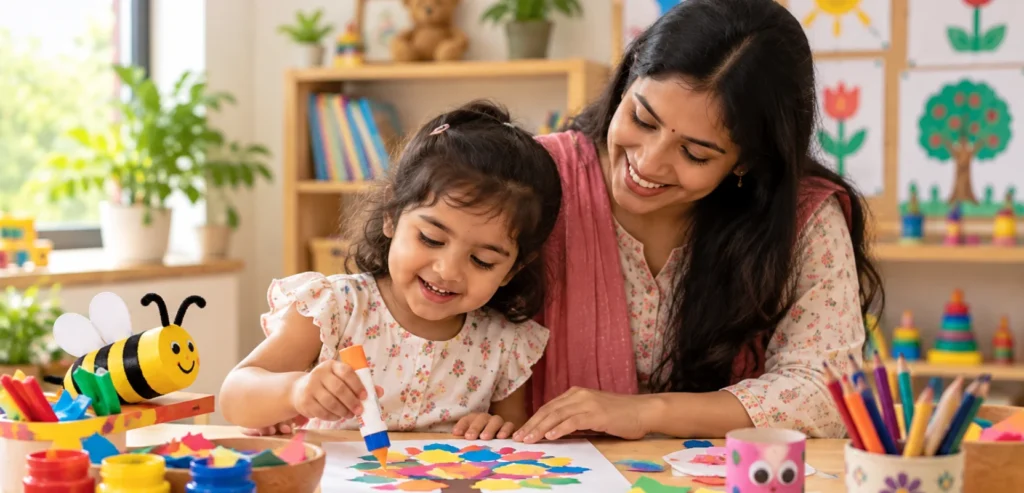
To tell the truth. No one hands a three-year-old a glue bottle to fix his handwriting. But that is exactly what occurs. When a child glues, draws, paints or squishes clay or homemade dough, small motor skills develop and those matter for writing later. Fine motor skills are the small muscles in the hands and fingers doing their job, and writing, drawing and buttoning clothes all lean on them.
| Area | What the child does | What it builds |
| Physical | Glues, draws, paints, shapes clay | Small motor skills for future writing |
| Language | Hears names for materials and tells you about the picture | Vocabulary and early literacy |
| Social and emotional | Focuses, makes choices, feels successful | Self-control and the focus needed for school |
| Thinking | Plans and solves small problems | Planning and problem-solving skills |
Every activity works out the hands in its own specific way.
- Cuts improve hand-eye coordination and accuracy.
- Glueing small pieces takes precision, and squeezing a glue bottle teaches how much pressure is enough.
- A crayon takes real hand strength and control to hold and steer.
- Stringing beads helps to improve concentration and hand-eye coordination.
- Dough play is a favourite for a reason. Squeeze, roll, pinch, poke. Many muscles in the hand are working at once.
Then there is process art. Children explore materials with no predetermined end product. It can be fun and joyful, it builds curiosity and resilience and asks very little of the adult in prep time. And here’s the kicker: copying a sample teaches following directions and careful hand control, but open-ended art gives much richer opportunities to think, talk and get along with others. Art and craft for preschool works best when an adult sets out the materials and then steps back.
This is evident in a school’s planning of a day. Art and craft is one of the activities listed on the curriculum page at The Little Scholar, a play school in Noida that has been working with young children since 1989. It is part of a combination of structured and unstructured learning.
Simple Paper Craft Ideas For Preschoolers
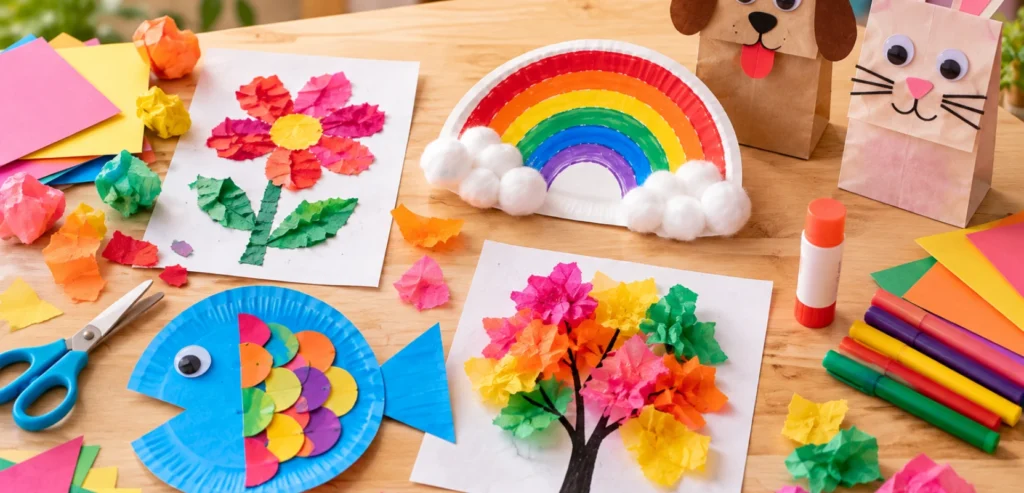
Just regular paper. Easy arts and crafts for preschoolers often start with tearing, not cutting.
Six Craft to try:
- Squash and tear it. Tearing strips and making paper balls develops strength, control and co-ordination. Then snipping with child-safe scissors.
- Collage of torn paper. A large sheet of drawing paper, a bunch of coloured scraps and a glue stick. That’s all you need.
- Tissue paper artwork. Children tear up tissue paper and stick it onto card to build up colourful artwork.
- Rainbow on paper plate. Colour half a plate in rainbow colours and paste cotton balls at the ends for clouds.
- Fish on paper plates. Cut a triangle on one side for mouth. The piece you cut off is the tail.
- Paper bag puppets. Decorate a brown paper bag with markers, crayons, or glued-on cutouts.
Scissors require patience. Developing a cutting habit takes time so start slow and don’t stress. Start with thick lines, then simple shapes with a grown-up helping. Go for the bigger shapes. They’re easier. Save the fiddly tiny ones for later. And make sessions short. Adjust the activity to suit the child’s age and stop it before boredom sets in.
Easy Painting and Drawing Activities
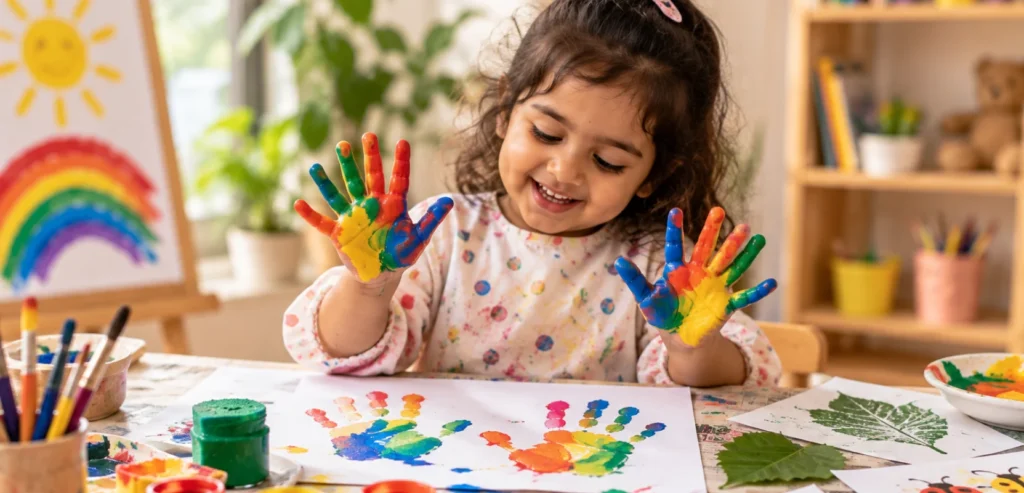
Painting is the messiest of the preschool art and craft. Usually it is also the most loved. And it’s a workout, too. Art activities develop hand control, creativity and focus, and motions such as brushing, gripping and peeling work on a number of fine motor skills.
Five easy ways to begin:
- Finger painting and hand prints. Fingertips, palms and edges of the hands all spread washable paint nicely, and there are no lines to stay in. Turn a painted handprint into a butterfly, a flower or an animal. Press a paint-covered hand, let the print dry, then finish with a marker or a little more paint.
- Sponge painting. Sponge shapes dipped in washable paint cover a lot of paper fast, and there is no brush to wrestle with.
- Prints of leaves. Paint one side of a leaf and press it on paper. Want it drier? Place a leaf under a piece of paper and rub a crayon over the top until the pattern appears.
- Bugs in fingerprints. With the details inked on, thumbprints can turn into ladybirds or bees.
- Dots of cotton swabs. By dipping cotton swabs in paint, small dots and repeating patterns are easy to make.
For two to four year olds, good options include finger painting, sponge dabbing, vegetable printing and big-brush watercolours on wet paper. Go big on the paper, too, because bigger sheets give small arms space to move. And do yourself a favour. An apron or old shirt, plus a table covered in newspaper or a plastic sheet, saves a lot of frustration later.
Drawing has its own timeline. Around 4 to 5 years, drawings begin to look like real things, even if small details are still missing. Milestone checklists make it more obvious. The list of skills tells you what 75% or more of children can do at that age.
| Age | Drawing and hand skills most children show |
| 3 years | Draws a circle when shown how to string large beads or macaroni |
| 4 years | Draws a person with three or more body parts; holds a crayon or pencil between fingers and thumb, not a fist |
A checklist is no substitute for a formal developmental screening. If you are worried about something, talk to your child’s doctor. A good start for three-year-olds is an activity box with paper and crayons. Draw shapes and lines together.
DIY Projects with Recycled Materials at Home
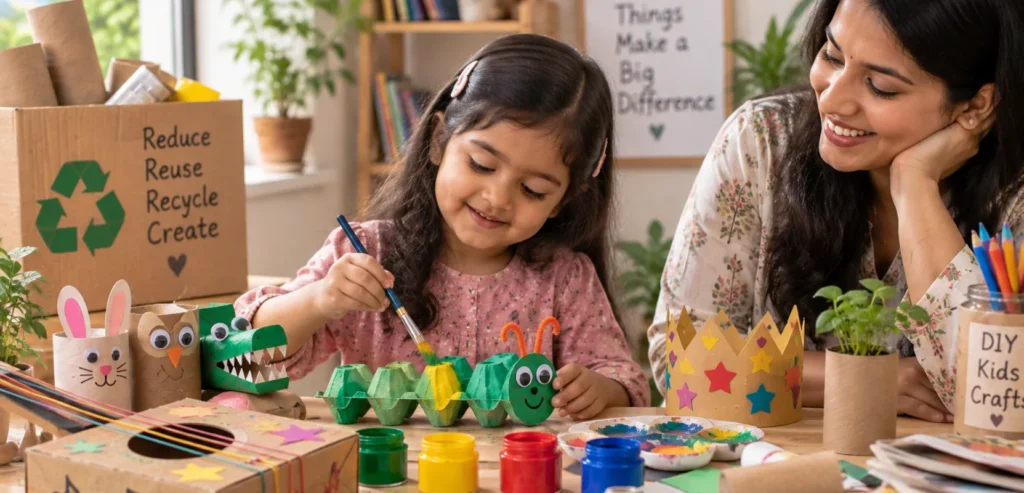
The truth is, you probably already have a craft kit. It’s in the recycling bin. See it.
Art and craft for preschool does not have to be expensive. With clean household items, some adult guidance and a little imagination, ordinary objects can become real learning. Start with an egg carton or a cardboard box for easy arts and crafts for preschoolers.
| Item at home | What preschoolers can make |
| Egg carton | Paint or decorate the sections to make a caterpillar |
| Old magazines | Snip bright pieces from old pages and lay them out as a mosaic picture |
| Newspaper and a toilet roll | Wrap newspaper around the roll, fill it with soil and add seeds |
| Cardboard packaging | A pretend crown, decorated with paper scraps and drawings |
| Cardboard box and rubber bands | A pretend guitar, where changing the bands changes the sound |
| Clean container with a secure lid | A pretend drum |
| Toilet paper rolls | Colour them brightly and glue on arms, legs and teeth cut from paper |
| Clothes pegs | Colour a peg green, stick paper teeth on both sides and draw eyes to make a biting alligator |
| Newspaper strips and cardboard | Stick strips on until the whole card is covered, then hang it on the wall once dry |
One nice side effect is that kids love to make something cool out of ordinary used objects like toilet paper rolls. By cutting apart the cups and decorating them, you can turn even plain egg cartons into flowers, bugs, animals or small sculptures.
Make a maker bin of cardboard, tubes, egg cartons, old magazines. Prep is key. Rinse bottles and cans Cover sharp tin edges with tape. Flatten boxes and let all dry. “Hot glue is for grown-ups. And a bonus for you. One easy way to talk about buying less and wasting less is recycling things.
Safe Art and Craft Materials for Preschoolers
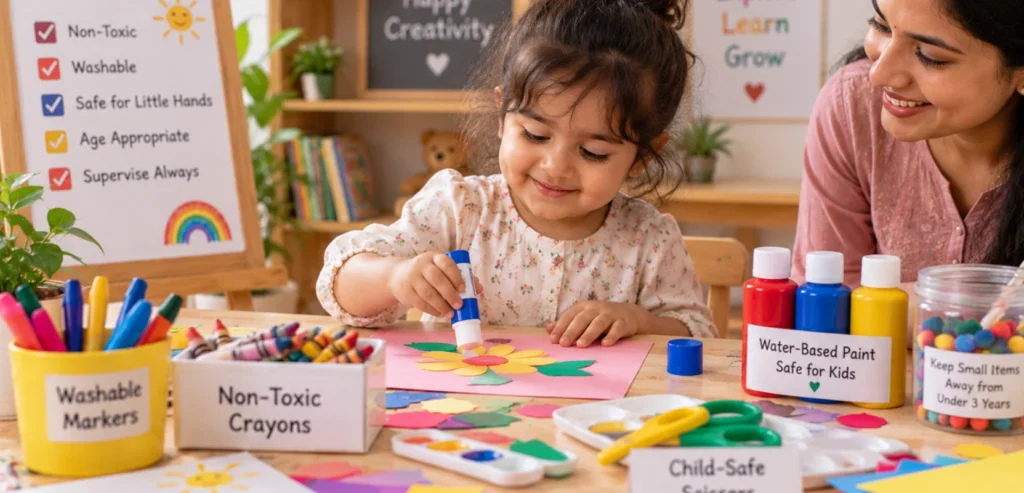
Safety is the dull part of art and craft for preschool. And it’s also the thing that makes everything else possible. Boring, okay. Never skipable. Kids younger than 3 put things in their mouths, so choking is a real danger. Under-threes are more likely to eat art supplies than older children.
| Supply | What to check |
| Crayons and paints | Look for a label saying non-toxic; washable supplies are a good pick for toddlers. |
| Markers | Water-based markers are best. Permanent markers are likely solvent-based. |
| Paint | Use water-based paint and a brush. Skip spray application. |
| Glue | A glue stick beats spray adhesive, which is not recommended. |
| Scissors | Supervise children when materials are sharp. |
| Beads and buttons | Take age warnings on the pack, such as those for under threes, seriously. |
| Homemade dough | Children should not put it in their mouths. It is extremely salty. |
| Found or donated materials | Skip them unless they come in the original, fully labelled container. |
A couple of habits go a long way. Three-year-olds may need a hand under three. Toddlers need projects made for them. Keep materials in their original container, with the ingredient and safety information. No eating or drinking during art time. Wash hands when you are finished. A non-toxic label alone, without certification, is misleading. And old modelling materials can hide toxic substances, so avoid anything old or unlabelled.
Tips For Making Art And Craft Fun For Preschoolers
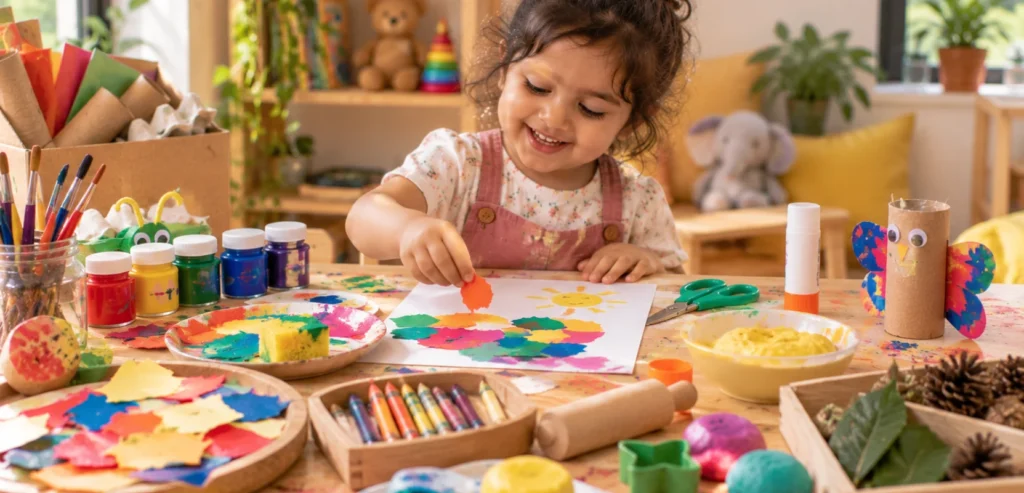
The biggest change is from product to process. Here’s how the two stack up.
| Process art | Product art | |
| Sample | No sample, pattern or model | Child follows a sample or model |
| Right and wrong | No right or wrong way | There is a right way and a wrong way |
| Adults | Have no idea what will be created | Know in advance what it will look like |
| Child’s reaction | Asks for more time and more paper | Keeps checking if it looks right |
And now the practical bit.
- Provide art a home. A special bin or drawer for materials is a good idea, and lots of blank paper is better than colouring books.
- Change the tools. Brushes, toothbrushes and potato mashers make interesting marks.
- Dough days. Add. Stirring and kneading no-cook dough (flour, salt, warm water and oil) develops small hand muscles, and measuring adds early maths.
- Let the child take the lead. Treat art as open-ended play. Try different materials and see what happens. Regularly bring in new ones.
- Be nice. Give lots of paint, colours and time for children to complete their own ideas.
- Let them decide whether a piece goes home or stays at school. It is their art and not yours.
- Go outdoors. Leaves and other natural materials are good art supplies and painting outside changes the setting.
- Talk it through. Name materials and ideas such as scissors, collage, sticky and smooth. Those conversations make vocabulary blossom.
Schools can give all this its own place. The Little Scholar features an activity centre that provides hands-on learning through art, music and interactive play.
Four things to keep in mind:
- Start cutting before tearing.
- Choose washable, water-based materials and stay close.
- Have some recyclables.
- Focus on the doing, not the finished picture.
So begin with the small. Monday: A collage of torn paper. Wednesday, printing Sponge. Egg Carton Caterpillar this weekend It’s messy. It’s noisy. It’s learning. That’s art and craft at its best for preschool. The idea is simple: The Little Scholar describes its methodology as a combination of play and education, and a glue stick is one of the best examples of that in action. That’s it.
FAQs
It develops the small motor skills needed for future writing, expands vocabulary as children talk about what they make, and encourages self-control and focus. It builds curiosity and resilience too.
Early, if the project is age appropriate. For under-threes, projects need to be toddler-designed and may need some help for three-year-olds. Stay close because children up to 3 years old put things in their mouths. By three most children can draw a circle when shown. By four a person with three or more body parts.
So be it. In product art the adults want to fix the work, and the children start asking if it looks right. Remember, it’s the child’s art, not yours. Learning is in the doing. However, tell them about it instead.