
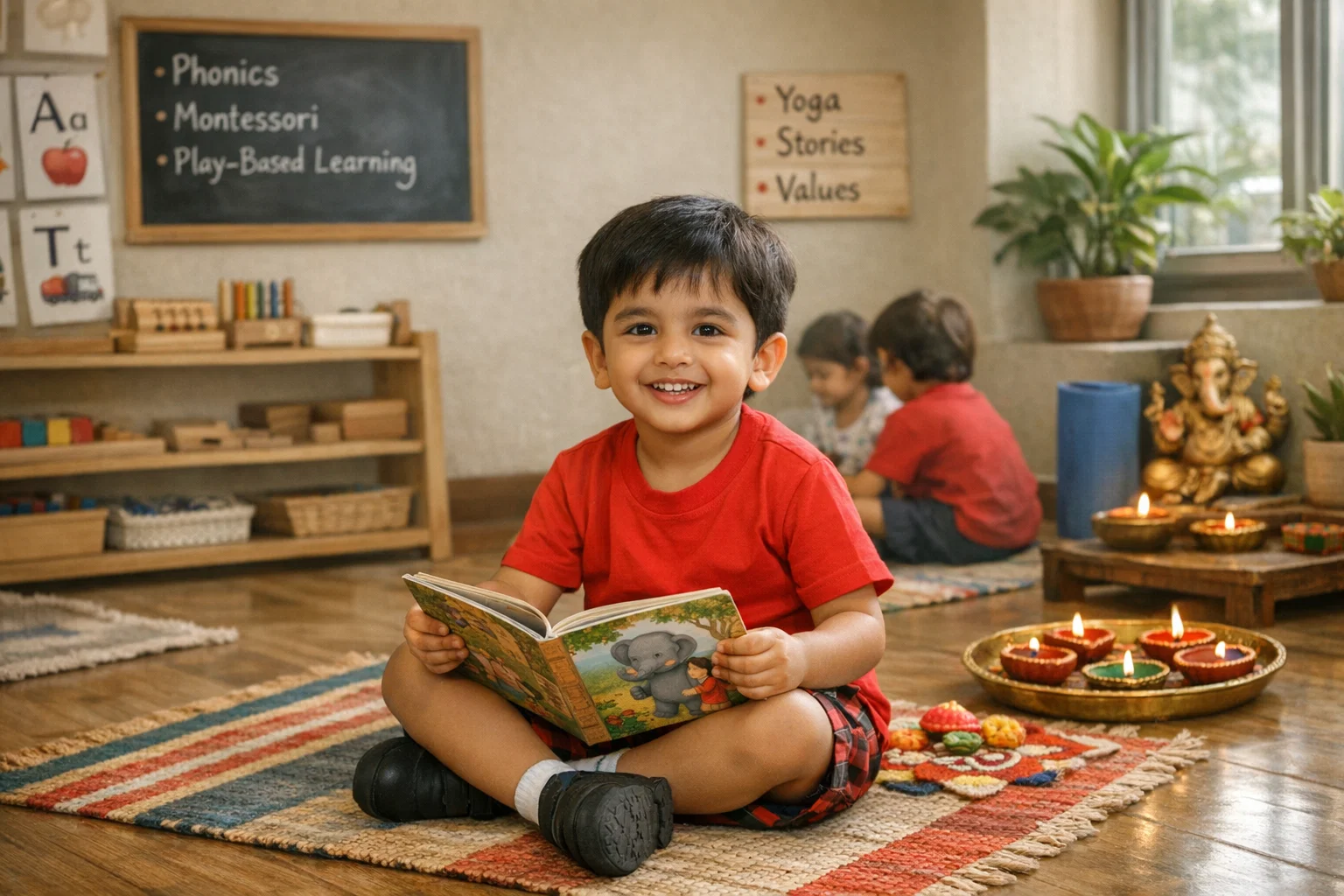
1. Introduction: The Modern Indian Parent’s Question
Many parents today find themselves pausing at a familiar crossroads. On one hand, they want their child to grow confident, expressive, and comfortable in a global environment. On the other, they want that same child to stay rooted in Indian values—respect, empathy, cultural familiarity, and emotional grounding. This is where Playschools in Noida Blend Global Techniques with traditional wisdom, offering a middle path that feels both modern and deeply rooted.
This is no longer a rare dilemma. In fact, India’s preschool education market crossed $957 million in 2023, driven largely by urban families who no longer accept “either-or” choices in early learning. Parents in metro cities expect their children to be globally ready without losing cultural identity.
That expectation is shaping how early education is designed today. This is especially visible in evolving urban ecosystems, where the idea of early schooling is no longer limited to alphabets and numbers, but reflects a deeper balance between modern pedagogy and traditional values.
This blog explores how that balance is being achieved—and why it matters more than ever for the urban toddler.
2. The Shift in Early Education: From Rote to Rooted Learning
Why Early Childhood Education Looks Different Today
Early education in India has undergone a quiet but meaningful shift over the last decade. Earlier models focused heavily on memorisation, early writing, and structured outcomes. However, research and policy have reshaped that thinking.
With the introduction of NEP 2020, early childhood education (ages 3–8) now emphasises play-based, multilingual, and experiential learning. Studies show that nearly 90% of brain development happens before the age of six, which means emotional security, communication, and curiosity matter far more than academic pressure at this stage. (source : firstthingsfirst.com)
As a result, urban parents increasingly value how their child learns, not just what they learn. They look for environments that support confidence, self-expression, and identity-building—without overwhelming toddlers too early.
3. Global Techniques Shaping Today’s Playschools
What “Global Learning” Really Means for Toddlers
When parents hear the term “global learning,” it often sounds abstract. In practice, however, it refers to a set of child-centric methods that prioritise development over performance.
Many modern urban playschools now adopt approaches such as:
- Phonics-based language learning, which helps children understand sounds naturally instead of memorising spellings
- Play-based and inquiry-led activities, where children explore concepts through hands-on engagement
- Montessori-inspired independence, encouraging children to make choices and develop self-reliance
- Social and emotional learning (SEL), focusing on empathy, cooperation, and emotional awareness
Importantly, these techniques focus on how children think and feel, not just on early academic milestones. This approach aligns with global best practices, while also supporting long-term confidence and adaptability.
4. Indian Values That Still Matter in Early Childhood
Cultural Grounding in the Early Years
While global techniques shape learning methods, Indian parents remain deeply invested in cultural continuity—especially during the early years.
For toddlers, values are not taught through lectures. Instead, they are absorbed through everyday experiences. Simple elements play a powerful role, such as:
- Familiar rhythms created through festivals, stories, and music
- Yoga and mindful movement, helping children develop body awareness and calmness
- Short shlokas and moral stories that introduce ideas of kindness, respect, and gratitude
- A warm, predictable environment that gives children a sense of belonging
When cultural grounding is woven into daily routines, children feel secure rather than confused. They grow up recognising their roots naturally, without feeling restricted by them.
5. Where the Two Worlds Meet: Curriculum Fusion in Urban Playschools
Blending the Global With the Local — Naturally
The most effective early learning environments are those where global methods and Indian values do not compete—they complement each other.
Across metro cities, several practical examples of curriculum fusion are now visible:
- Phonics sessions paired with Indian storytelling, where sound recognition is strengthened through familiar narratives
- Yoga-based movement integrated into playtime rather than formal instruction
- Celebrating international observance days alongside Indian festivals, helping children appreciate both worlds
- English communication encouraged, while cultural context remains familiar and comforting
This blend is especially evident in urban centres, where parental expectations are diverse and exposure is broader. A thoughtfully designed playschool in Noida, for example, often reflects this balance because the city itself sits at the intersection of global influence and traditional family values.
6. Why Metro Cities Enable Better Curriculum Balance
The Urban Ecosystem Advantage
Metro cities naturally support this fusion of learning styles. The ecosystem itself encourages balance.
Cities like Noida bring together parents with varied professional backgrounds, global exposure, and shared aspirations for their children. This diversity shapes school expectations and pushes institutions to evolve.
Additionally, urban playschools benefit from:
- Well-trained educators who undergo continuous professional development
- Access to structured frameworks under NEP, while remaining flexible in execution
- Infrastructure that supports safety, communication, and transparency
Rather than being the focus, Noida functions as a case-study city—much like Mumbai or Bengaluru—where global exposure and cultural continuity coexist. This is why the concept of a playschool in Noida often mirrors broader metro trends instead of standing apart from them.
7. What Parents Should Look For Beyond Buzzwords
Asking the Right Questions at a Playschool
For parents evaluating options, glossy brochures and popular labels rarely tell the full story. Instead, the right questions reveal how genuine the balance truly is.
Parents should ask:
- How are global methods adapted for Indian children on a daily basis?
- Is cultural learning part of routine activities or limited to annual events?
- How does the school balance structure with warmth and flexibility?
- Are values demonstrated through behaviour and practice rather than performance?
In real decision-making conversations around a playschool in Noida, parents increasingly prioritise classroom observation over marketing language. They look for calm spaces, responsive teachers, and children who appear secure and engaged.
8. The Child’s Experience: Why This Balance Helps Toddlers Thrive
Confidence Without Confusion
When global techniques and Indian values are thoughtfully blended, the impact on children is visible.
Toddlers benefit through:
- Stronger communication skills, supported by phonics and storytelling
- Emotional security, created by predictable routines and familiar cultural cues
- Cultural comfort without rigidity, allowing identity to form naturally
- Smoother transitions into formal schooling aligned with NEP expectations
The urban toddler grows up navigating a wider world. When learning environments reflect both future readiness and emotional grounding, children gain confidence without confusion.
9. Conclusion: Raising Global Thinkers With Indian Roots
The best early learning environments do not force families to choose between East and West. Instead, they recognise that modern Indian parenting demands both.
Across metro ecosystems, the evolving idea of a playschool in Noida reflects this shift. It represents a broader movement where curriculum design mirrors how families live today—globally connected, yet culturally anchored.
When learning feels balanced, intentional, and humane, children are better prepared for both school and life.
Parents exploring early education options are encouraged to:
- Spend time observing classrooms
- Ask how learning methods are adapted for real children
- Choose environments that feel calm, balanced, and thoughtful
If you are currently exploring a playschool in Noida and would like to understand how such balance can be experienced in practice,
👉 Click here to contact The Little Scholar Playschool, Sector 19, Noida
Because the right beginning is not about choosing between worlds—but helping your child feel at home in both.