
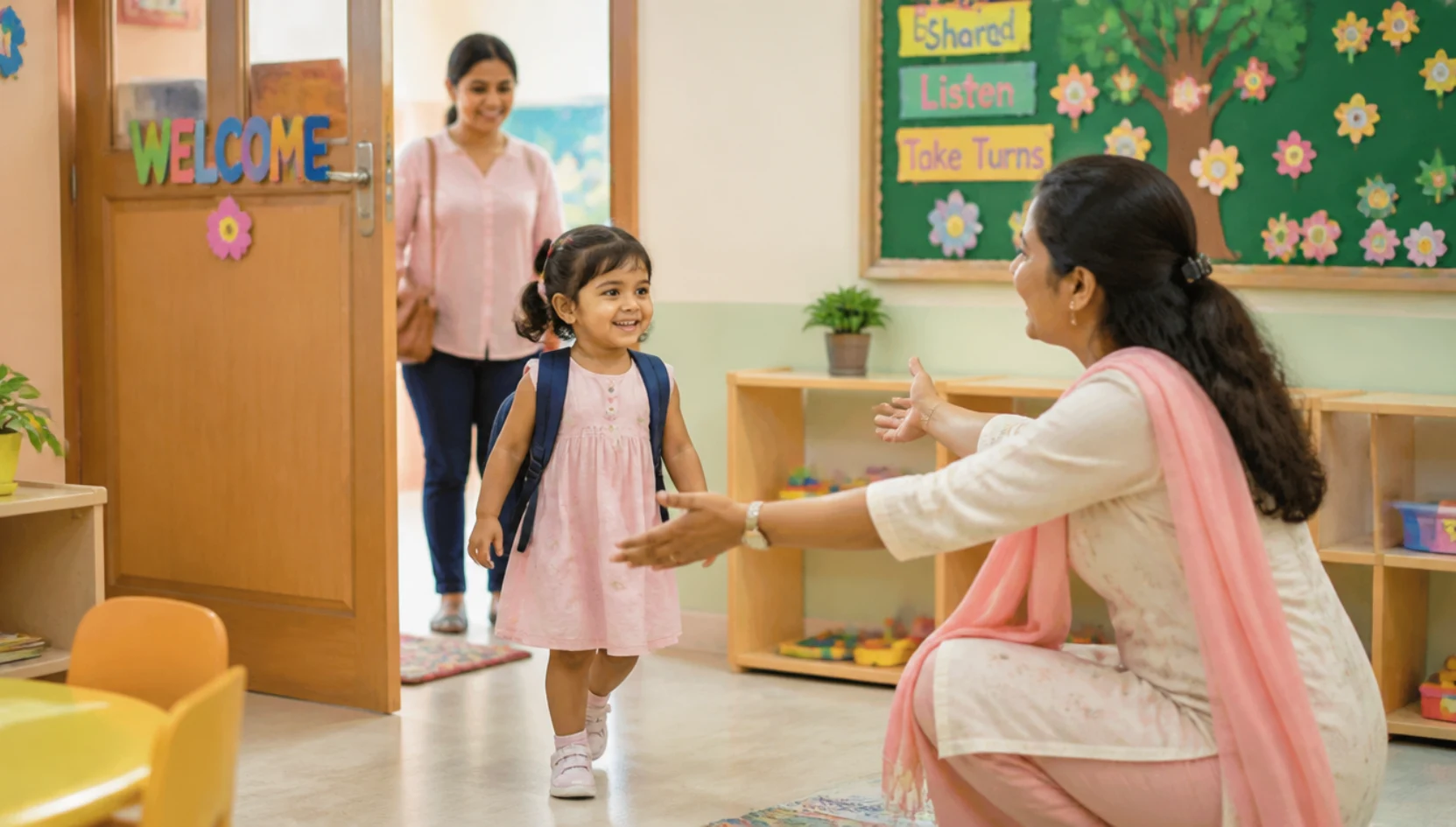
Every parent will come to that point in their lives when they have to ask themselves one big question, is my kid truly ready for preschool? Indeed, preschool is not only a big step for your kid but also for you as a family. As a rule, going to preschool is considered to be a starting point in the child’s education process when he/she starts developing socially and learns how to feel independent and exploratory.
As a matter of fact, Signs Your Child Is Ready for Preschool have nothing to do with your kid’s abilities to recite the alphabet or count from one to ten. Being ready for going to preschool means being emotionally mature, curious, communicative, and capable of adapting to a new environment. Each child develops differently, and by recognizing the right developmental signs, you will be able to make the right decision regarding preschool enrollment without putting any additional pressure on your kid.
If you plan to send your baby to a preschool in Noida, this article will help you recognize the right signs.
What Does It Mean When Your Child Is Ready for Preschool?
It is common for many parents to view preschool readiness in terms of academic knowledge. Though understanding colors, shapes, or letters might indeed be useful, such skills only make up a small percentage of what preschool teachers see in a child.
The preparation of a child for preschool should focus not on knowing everything but rather being open to exploring and learning in an active and structured environment.
Preschool is where a child learns important skills to be used throughout their life; therefore, it should not be viewed as a regular classroom from the start.
It should not be seen as an ordinary classroom right from the beginning.
The following are some of the areas which can help determine whether a child is ready for a preschool setting:
- The confidence in oneself in order to separate from one’s parents for extended periods.
- Being interested in socializing and playing with other kids.
- Following instructions.
- A curiosity to engage in new activities, stories and environment.
- Self-care skills such as feeding oneself or being able to wash hands with a little help.
All of these will make it easier for a child to adapt to the new environment of the preschool.
The other thing to bear in mind is that children develop at their own pace. Two children at the same age might possess different abilities and it is absolutely okay..
Why Preschool Readiness Matters More Than Early Academics
One of the most common myths held by contemporary parents is that children should already have some academic readiness before attending preschool.
On the contrary, preschool education pays far more attention to the development of the entire child rather than his/her academic readiness.
Studies have found that children, who have been emotionally and socially prepared, adjust better than those who can recite numbers and letters.
Think about a child, who is able to count to twenty, but cannot share his/her toys or part with parents. The adjustment will be difficult for him/her regardless of academic skills. At the same time, a child, who has an interest in learning, expresses his/her basic needs and enjoys being with other people, will easily adjust to preschool despite his/her inability to read letters of the alphabet.
Pre-school prepares children with:
- Social and emotional confidence.
- Communication and listening skills.
- Skills of problem solving through play.
- Creativity and imagination.
- Fine and gross motor skills.
- Independence in daily activities.
These formative experiences equip children not only for kindergarten but also for learning throughout life.
Instead of focusing on, “Can my child read or write?”, parents need to focus on whether their child:
- Is interested in the world around them?
- Can communicate basic needs?
- Loves to explore new experiences?
- Is slowly but surely growing independent?
Such questions give much more insight into preschool readiness than academic achievements alone.
Knowledge of these developmental points will help you identify The Signs Your Child Is Ready for Preschool without a doubt and without unnecessary haste or delay.
The next step is learning to spot these signs in real life.
Emotional development, communication, independence, curiosity there are many signs that tell parents that it’s time to start this fascinating journey. In the following section, we will look at the key signs you must spot before sending your child to preschool.
10 Signs Your Child Is Ready for Preschool
Not all children will reach developmental milestones at the same rate, which means that no list will be applicable to all children. But early childhood education professionals generally look for the development of a range of emotional, social, physical, and communication skills that make children suitable for the preschool setting.
If you have been thinking about whether your child is ready for this new stage of life, here are some of the most commonly found Signs Your Child Is Ready for Preschool.
Emotional and Social Readiness
1. Your Child Can Spend Short Amounts of Time Separated from You
It is absolutely natural for children to feel nervous being separated from their parents during the first days in preschool. The important thing is whether he or she feels more comfortable after being occupied with some activity.
If a child can spend time with grandparents, other relatives or any trusted person without being too upset, it means that he or she develops emotional safety. This will facilitate the process of adaptation to the new place.
Note that some tears on the first day do not mean that the child is not ready to go to preschool. Professional educators know how to calm down children.
2. They Like to Play with Other Children
One of the first places where a child develops friendships, communicates with other children, and learns to work together is preschool.
Your child may:
- Enjoy going to parks or playgrounds.
- Observe other children and try to imitate their actions.
- Sometimes share toys.
- Play group games.
- Get excited about meeting other children of the same age.
It’s not necessary for a child at this age to share all the time or solve conflicts on their own.
3. They Are Able to Follow Simple Directions
The Sign Your Child Is Ready for Preschool that is often quite clear and obvious is the ability of your little one to listen to and follow simple directions.
For instance, he/she can react in a positive way to your requests such as:
- Put away their toys.
- Wash their hands before meals.
- Sit for a story session.
- Get their shoes.
- Stand in line prior to outdoor activities.
The ability to follow simple directions is crucial in helping kids be an active part of the class and makes it easier for teachers to handle the whole group of children.
Communication and Learning Skills
4. Your Child Is Able To Express Basic Needs
Your child does not have to form full sentences before attending preschool. However, he/she should be able to express basic needs, such as:
- “I am hungry”
- “I need water”
- “I want to use the washroom”
- “I am sleepy”
- “Can you help me?”
This ability will help children feel safer and enable teachers to attend to their basic needs right away.
Telling stories, singing songs and holding conversations at home will definitely help develop your child’s communication skills.
5. They Are Curious and Enjoy Exploring
Curiosity is one of the best signs of lifelong learning.
- Is your child always asking questions such as:
- Why is the sky blue?
- What is that bird doing?
- How does this toy work?
- Do they love:
- Constructing with building blocks?
- Going through picture books?
- Exploring nature?
- Doodling and coloring?
- Engaging in different kinds of activities?
A curious child is usually always excited about discovering things from their environment, which makes early childhood education classes full of possibilities for them.
6. The Ability to Concentrate on an Activity for 5–10 Minutes
It is normal for young kids to have limited attention spans, which is why it is not expected that they should be able to remain still for long.
What you should focus on is if your child is able to concentrate on one activity for about 5–10 minutes, which may include things like:
- Finishing a simple puzzle.
- Listening to a story.
- Coloring.
- Playing with building blocks.
- Playing make-believe games.
This ability indicates the ability to concentrate on classroom activities without being overwhelmed.
Daily Independence and Physical Development
7. Your Child is Beginning to be More Independent
In preschool, kids are taught to accomplish certain tasks by themselves, so that they can feel independent and responsible.
- Examples of such skills include:
- Being able to eat by himself/herself.
- Drinking from an uncovered glass.
- Learning how to wash hands with little help.
- Putting on simple shoes and removing them.
- Carrying his/her own school bag.
Kids do not have to know how to perform all self-help activities before coming to preschool.
All they need to do is to be ready to attempt them.
8. Show Interest in Daily Routines
When children comprehend simple routines, they easily adapt to preschool activities.
Some of their signs include:
- Waking up at set times.
- Understanding mealtime routines.
- Knowing bedtimes.
Easily moving from one activity to another using gentle reminders.
Routines make children feel comfortable since they know what will happen next. In preschool, there is a set daily routine that makes familiarity with home routines advantageous.
9. They Feel Comfortable Investigating a New Surrounding
One of the most significant signs of readiness would be confidence in new surroundings.
Maybe your baby loves to:
- Go to a new playground.
- Meet new people.
- Explore new toys.
- Attend family events.
Although at first they would stick to you and then begin exploring on their own.
It is a good sign for your baby’s emotional readiness to investigate a new learning surrounding.
10. They Have a Learning Mindset
One of the most positive Signs Your Child Is Ready for Preschool is a natural love for learning through play.
Preschool education does not consist of worksheets and drills. Instead, preschool teaches children to learn by:
- Pretend play and role playing.
- Painting and creating art projects.
- Singing and dancing.
- Story telling.
- Creating and building.
- Exploring outside.
Children who like exploring, asking questions, and learning new things are well on their way to enjoying preschool.
In other words, play time is learning time for young children.
It is worth mentioning that not every single quality listed above should be present in your child before he or she starts preschool. There may be children who are excellent communicators, but slow to become independent. And there may be children who are extremely curious, but shy among strangers. Each child develops differently.
So think of these signs not as requirements, but as useful guidelines to assess how your child develops. With good support of you, the parent, and teachers, many of these skills can develop further once your child begins his or her preschool experience.
Common Myths About Preschool Readiness Every Parent Should Ignore
Prepping your kid for preschool is indeed exciting; however, this phase brings along numerous recommendations from friends and family members, as well as posts from social media pages. Although some recommendations are indeed useful, many stem from misconceptions that have nothing to do with today’s realities and cause undue stress.
Here are some interesting facts about popular myths surrounding early childhood education.
Myth 1: My Child Must Know the Alphabet and Numbers Before Preschool
One of the most common myths is that kids should already know their letters, be confident in counting or at least be able to write their names in order to attend preschool.
In fact, preschool is the place where they acquire these skills by means of play-based learning. Preschool teachers teach them letters, numbers, colors, shapes and develop their literacy skills without making them feel nervous and scared.
More important is how much your kid is ready to take part in these activities.
Myth 2: A Shy Child Isn’t Ready for Preschool
Most parents are concerned that their shy child may not be able to adapt to the classroom setting.
But shyness is a personal characteristic,it does not mean that the child is unprepared for school.Some kids observe first and then participate; others dive straight into action. Both types of kids are perfectly okay.
With the help of understanding teachers and interaction with peers, shy kids can overcome their shyness.
Myth 3: Children Should Never Cry on Their First Day
It is only normal that parents expect that everything will go well on the first day, but tears do not always indicate anything is amiss.
Children tend to suffer from separation anxiety on their first few days or weeks in school. As they get acquainted with their teachers, classmates, and school environment, they soon get comfortable.
Routine and assurance matter much more than trying to make the transition emotionally painless.
Myth 4: Every Child Should Reach Milestones at the Same Age
Comparing kids is one of the most common ways to place undue stress on them.
One kid might talk confidently by two and a half, whereas the other might be better at communicating a few months later. Some kids are independent right from the beginning, whereas some kids take a little more time.
Development is not a competition.
Stop comparing your child to others, but instead appreciate his or her growth at every step of the way.
Knowledge of these myths will help you understand The Signs Your Child Is Ready for Preschool.
How Parents Can Prepare Their Child for Preschool at Home
Starting preschool isn’t just about preparing children,it’s also about preparing the family for a new routine. Small, consistent habits at home can make the transition smoother and help children feel secure before their first day.
Build a Predictable Daily Routine
Children thrive on routine because it helps them understand what to expect throughout the day.
A few weeks before preschool begins, try establishing regular times for:
- Waking up
- Meals and snacks
- Outdoor play
- Reading time
- Bedtime
A familiar routine helps children adapt more easily to the structured schedule they’ll experience at preschool.
Encourage Independence Through Everyday Activities
Children gain confidence when they’re given opportunities to do things on their own.
Simple activities like:
- Putting away toys
- Washing hands
- Carrying a small backpack
- Drinking from an open cup
- Wearing simple shoes
help develop independence while teaching responsibility.
Remember, perfection isn’t the goal. Encouragement is.
Read, Talk, and Explore Together
Language development happens naturally through meaningful interactions.
Spend time every day:
- Reading picture books together.
- Asking open-ended questions.
- Singing rhymes.
- Describing everyday activities.
- Exploring nature during walks.
These experiences build vocabulary, improve listening skills, and encourage curiosity,all of which support early learning.
Make Preschool Feel Exciting
Children often mirror their parents’ emotions.
Instead of asking,
“Are you nervous about school?”
try saying,
“You’re going to meet new friends, listen to fun stories, and discover so many exciting things.”
You can also:
- Visit the school before the first day if possible.
- Practice carrying their school bag.
- Read books about starting preschool.
- Create a simple goodbye routine.
A positive approach helps children view preschool as an exciting adventure rather than something to fear.
Parents don’t need to teach formal lessons at home. Their role is to nurture confidence, curiosity, and independence, qualities that prepare children for a successful preschool experience.
In the next section, we’ll explore how choosing the right learning environment can make all the difference in supporting your child’s early development and long-term success.
How to Choose the Best Preschool in Noida for Your Child
Selecting a preschool is one of the first big choices in terms of education that you will have to make as a parent. Although all schools will claim themselves as centers for quality education, the ideal preschool will be that which knows child development, provides safety and helps every child grow according to his own pace.
If you are looking for a preschool in Noida, you will find that there are a number of choices before you. Rather than basing your choice on where the school is situated and how popular it is, take some time to consider the following aspects.
A Safe, Secure, and Child-Friendly Environment
Children are more likely to learn effectively when they feel comfortable.
A preschool environment that is clean and organized should be observed. Well maintained premises, age-appropriate furniture, and appropriate safety arrangements reflect the school’s commitment to the wellbeing of the children.
The children should be provided with enough space for movement and interactions.
Experienced and Caring Educators
The role that teachers play during early childhood is one of the most crucial.
It is best to choose those teachers who are friendly, patient, and qualified in early childhood education. Good teachers do not merely give instructions but know the feelings of kids and motivate them and make them all inclusive.
It is best to observe teachers while interacting with kids. They will tell you more than any brochure or advertisement can.
A Play-Based Learning Approach
There is consensus among early childhood specialists that the best way of learning for young kids is through playing and discovery.
A good preschool includes a combination of structured activities along with chances for creative play, physical activity, stories, songs, art, and more.
Not only should children be involved in worksheets and learning through memorization, but they should be encouraged to inquire, problem-solve, and build confidence.
Also read: Top 12 Reasons Why Your Child Should Attend Pre-nursery School
Strong Parent-School Communication
The process of learning for children becomes more successful when there is cooperation between parents and educators.
Select a preschool where parents are kept up to date on everything taking place in the class, the development of children, and their experiences every day.
Meetings between parents and educators, activity reports, and open communication form mutual trust and make sure that children get the same care at home and at school.
Curriculum that Promotes Holistic Development
An ideal preschool education should be more than learning about letters and numbers.
It should facilitate:
- Language development
- Social and emotional development
- Physical development
- Creativity
- Critical thinking
- Problem-solving
- Independence
- Self-confidence
These are the competencies that enable children to succeed not only in primary school but also throughout life
While searching for the best preschool in Noida, one must look into the curriculum that promotes the holistic development of the child rather than just academic success.
A school that appreciates curiosity, kindness, self-confidence, and creativity usually equips the child for the future better.
Supporting Your Child’s First Step Into Learning
Children mature into their preschool readiness at different stages. There are those who walk right into class on their very first day of class, while others take some time getting used to things before they can fully engage. It is totally normal!
Rather than getting caught up in comparisons and developmental markers, watch how your child develops on a daily basis. Their curiosity, adventurousness, independence, communication, and social skills may tell you much more than a list would.
The Signs Your Child Is Ready for Preschool are not about perfection, but rather about steady improvement and a desire to learn. Your child will continue to develop all these skills and many others in spite of starting school.
While choosing the best preschool in Noida for your child, keep in mind that the perfect educational setting is that in which kids feel secure, appreciated, inspired, and enthusiastic about exploring the world around them. While a good preschool does not only help kids to prepare for their next class, it also helps them gain self-confidence, strength, develop friendships, and a passion for education.
Selecting the right school is indeed an important milestone, but the most precious gift you could ever give your child is your own patience and faith in his journey through life.
FAQs:
Most children begin preschool between 2.5 and 4 years of age, depending on their emotional, social, and developmental readiness. Instead of focusing only on age, parents should look for signs such as curiosity, communication, and growing independence.
No. Preschools are designed to introduce letters, numbers, and early learning concepts through fun, play-based activities. Children are not expected to master these skills before admission.
Create a consistent daily routine, encourage independence with simple tasks, read together every day, and give your child opportunities to interact with other children. These activities naturally build confidence and readiness for preschool.