
Introduction: The First-Day Anxiety Every Parent Understands
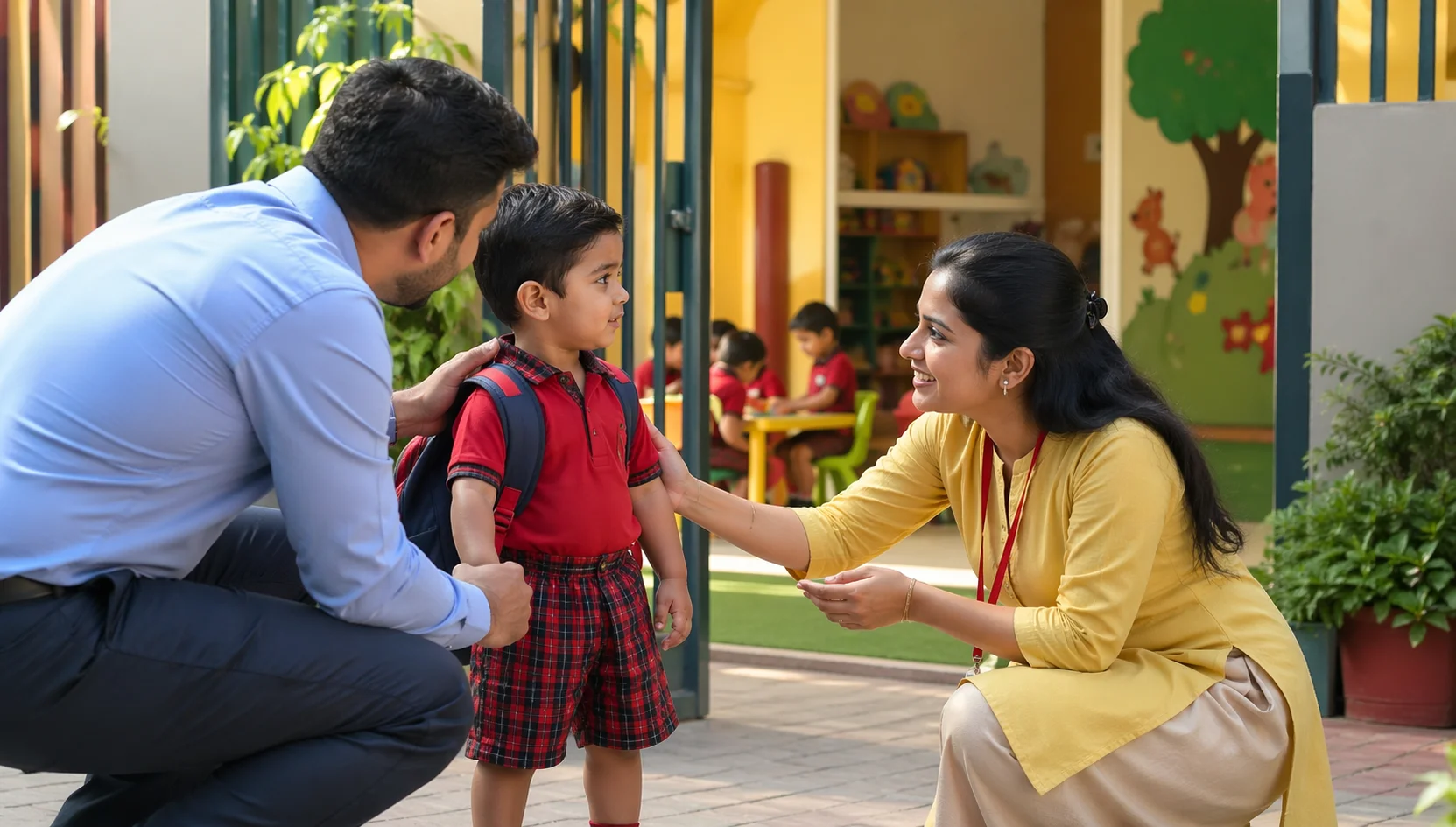
It’s a scene most parents don’t forget easily. You’re standing at the school gate, holding your child’s hand a little tighter than usual. Your child looks unsure. You feel unsure too. And for a moment, it’s hard to tell who is more anxious. The first day at a playschool in Noida often marks a child’s first real step into the outside world, making it a milestone filled with both excitement and emotion.
For many toddlers, especially in urban nuclear families, this is their first experience of being away from home for a structured period of time.
Studies suggest that nearly 30–40% of preschoolers experience separation anxiety in the initial weeks. In metro environments, where routines are tighter and transitions are quicker, this emotional shift can feel even more intense.
This is why preparing your child emotionally matters just as much as choosing the right school. A calm and thoughtful transition can make all the difference in helping children feel secure and confident as they begin their early learning journey.
Why the First Day Feels So Big for a Toddler
Understanding Separation Through a Child’s Eyes
To understand your child’s reaction, it helps to step into their world for a moment.
Toddlers thrive on familiarity. Their comfort comes from known faces, predictable routines, and safe spaces. When suddenly placed in a new environment—with new people, new sounds, and new expectations—it can feel overwhelming.
Globally, 10–20% of preschoolers show strong separation anxiety, but in India, that number often rises higher. Crying, clinging, or resisting school are not signs of weakness. They are natural responses to change.
For a toddler, the question is simple:
“Will my parent come back?”
Once you understand that this is the core emotion, your approach becomes more empathetic—and more effective.
The Urban Context: Why Preparation Matters Even More
Metro Lifestyles and Early Independence
In cities like Noida, parenting dynamics are evolving rapidly.
Nuclear families have become the norm. Extended family support is often limited. As a result, children may not experience gradual separation before starting school. The shift goes from always at home to structured environment almost overnight.
At the same time, urban life runs on tight schedules. Office timings, commute pressures, and fixed routines mean that playschools operate in a more structured manner.
This is where emotional preparation becomes essential. Choosing a playschool in Noida often means entering an organized system with defined schedules, safety protocols, and communication methods. While this is beneficial in the long run, it also means the child needs to feel emotionally ready to adapt.
Start Before Day One: Building Familiarity Early
Making the Unknown Feel Safe
One of the simplest yet most effective ways to ease anxiety is to reduce the “unknown.”
Research shows that pre-visits to school can reduce anxiety by over 50%. When children see their classroom, meet teachers, and explore the space, it stops feeling unfamiliar.
Here’s what helps:
- Visit the school a few times before the first day
- Let your child explore play areas freely
- Introduce them to teachers in a relaxed setting
- Talk positively about school at home
Even simple storytelling works wonders:
“You’ll meet new friends,” or “You’ll play with toys there.”
The goal is not to build excitement artificially, but to create comfort through familiarity.
Creating a Predictable Routine at Home
Why Routine Builds Emotional Security
Children find safety in predictability.
When daily routines are consistent, children feel more in control of their environment. This reduces anxiety and builds confidence.
Start preparing at least 1–2 weeks in advance:
- Fix a regular sleep and wake-up time
- Practice morning routines similar to school days
- Encourage small independent tasks like eating or carrying their bag
Studies suggest that children who follow predictable routines show up to 40% better emotional adjustment during transitions.
This consistency acts as a bridge between home and school.
The Power of Small Goodbyes (Not Long Ones)
Handling Drop-Off Without Stress
Drop-off is often the most emotionally charged moment—for both parent and child.
It’s natural to want to comfort your child with longer hugs or repeated reassurances. However, this can sometimes increase anxiety instead of reducing it.
What works better:
- Keep goodbyes short, calm, and confident
- Use a consistent phrase like “I’ll be back soon”
- Smile, even if your child is upset
Avoid sneaking away. While it may seem easier in the moment, it can create mistrust. Children need to know that when you leave, you also return.
Interestingly, studies show that children mirror parental emotions. If you remain calm, your child is more likely to settle faster.
Comfort Objects & Emotional Anchors
Bringing a Piece of Home Along
Sometimes, a small familiar object can make a big difference.
A favorite toy, a soft cloth, or even a small item from home can act as an emotional anchor. It gives the child something to hold onto when everything else feels new.
Research indicates that comfort objects help ease up to 70% of initial distress cases. (source : careforkids.com)
It’s not about dependency—it’s about transition.
8. What to Expect in the First Week
Normalising the Adjustment Phase
The first week of playschool is rarely perfect—and that’s completely normal.
You might notice:
- Crying during drop-off
- Mood swings at home
- Increased clinginess
- Sudden tiredness
Most children take 1–4 weeks to fully adjust, with the first week being the most challenging.
Instead of viewing this as a problem, it helps to see it as a process.
Every child adapts at their own pace.
Partnering with the Playschool
Why Teacher Communication Matters
The transition becomes much smoother when parents and teachers work together.
Modern setups, especially in a playschool in Noida, often include structured communication systems—daily updates, apps, or feedback sessions. These help parents stay informed without feeling anxious.
What you can do:
- Stay in touch with teachers
- Ask about your child’s behavior during the day
- Share any concerns openly
At the same time, avoid over-monitoring. Trust plays an important role in helping both you and your child settle into the new routine.
Signs Your Child Is Settling In Well
Small Wins That Matter
Progress may not always be obvious, but small signs indicate that your child is adjusting.
Look for:
- Talking about school casually
- Mentioning a friend or teacher
- Showing curiosity instead of resistance
These changes often begin to appear between the second and fourth week.
In a well-structured playschool in NCR especially in Noida, such transitions are supported through consistent routines and nurturing environments.
Common Mistakes Parents Should Avoid
What Can Make the Transition Harder
Even with the best intentions, certain habits can make the adjustment phase more difficult.
Avoid:
- Showing anxiety in front of your child
- Overpromising (“I’ll be back in 2 minutes”)
- Comparing your child with others
- Forcing excitement instead of acknowledging feelings
Studies show that parental anxiety can double a child’s distress levels. Staying calm and realistic helps build trust.
The Bigger Picture: Building Emotional Independence
More Than Just the First Day
While the first few days may feel overwhelming, this phase plays a much bigger role in your child’s development.
It helps build:
- Emotional resilience
- Social confidence
- Adaptability
Over time, children who adjust well to early separation tend to transition more smoothly into formal schooling.
This is why choosing the right environment—whether it’s a playschool in Noida or any urban learning setup—is not just about academics, but about emotional growth.
Conclusion: A Gentle Start Leads to Strong Confidence
The first day of playschool is not just about leaving your child at a classroom door. It’s about helping them take their first step toward independence.
Emotional readiness plays a key role in how that step feels.
When children feel safe, understood, and supported, they adapt faster and grow more confidently. In structured environments like a playschool in Noida, this balance between routine and emotional care becomes even more important.
A gentle start doesn’t just make the first day easier—it shapes the entire journey ahead.
As you prepare for this transition:
- Take things one step at a time
- Trust your child’s pace
- Focus on comfort over perfection
If you’re currently exploring a playschool in Noida and want to understand how a nurturing environment can support your child’s emotional readiness:
👉 Click here to contact The Little Scholar Playschool, Sector 19, Noida
www.thelittlescholar.co.in
Because the right beginning is not about rushing the process—but about helping your child feel ready for it.