
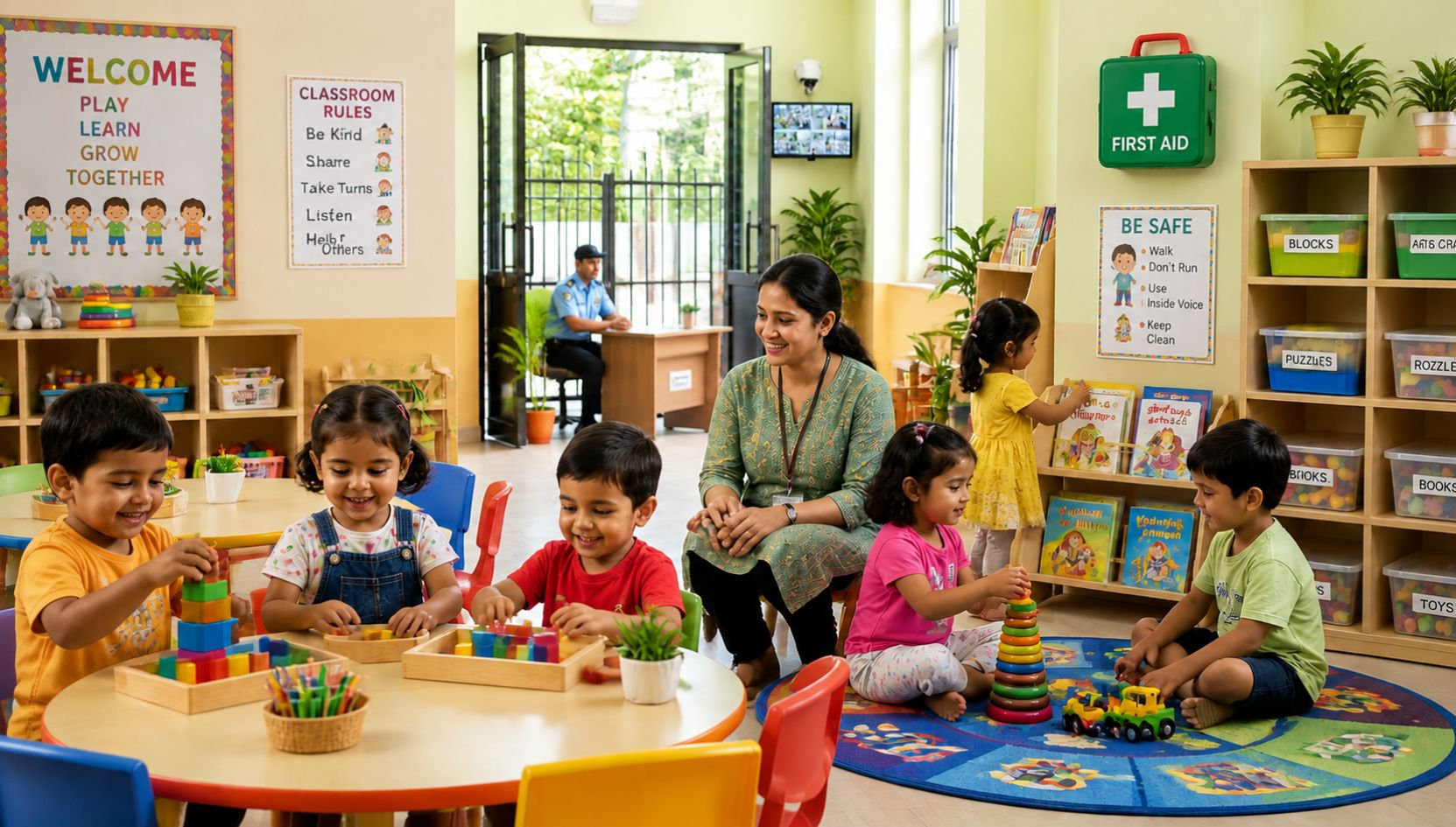
Choosing a school or preschool for your child is one of those decisions where a parent notices everything. Is the classroom clean? Are the teachers attentive? Is the entrance secure? What happens if a child gets hurt? And, perhaps most importantly, will my child be safe when I am not around?
These questions are completely natural. For young children, school is often their first experience of spending several hours away from their parents. That makes child safety an important part of choosing the right school in Noida.
What’s really impressive is that school safety is much more than CCTV cameras or door safety. Basically, this includes how teachers handle kids, visitor direction, emergency management, hygiene and sanitation, and the possibility for children to interact with grown-ups in case of problems.
For parents looking at schools and preschools in Noida, understanding these everyday safety practices can make the decision much easier.
Why Child Safety Matters at School
Children are naturally curious. They run, climb, explore, play, and interact with other children without always understanding what could be dangerous. A safe school does not try to stop children from exploring. Instead, it creates an environment where children can learn and play while sensible precautions are in place.
Safety starts with the school environment.
What’s interesting here is that a well-designed schoolhouse environment should be adapted to the needs of young children. Something to keep in mind is that the schoolrooms should have sufficient space to move, furniture should be age-appropriate, and potentially wild areas should be properly secured.
Is the goal to construct things more leisurely? In rationale, the state. In simple terms, the equipment must conform to the children’s electric Oven and be checked regularly to ensure compliance, making it possible to provide simpler explanations. Put differently, it is a cautiously planned method: floors and pavements must be clear enough to allow kids to move without unnecessary danger.
This is where child safety becomes part of the school’s everyday routine rather than something considered only during an emergency.
Supervision matters as much as security.
In practical terms, even the safest classrooms can become risky if children are left neglected, which combines theory with real-world application. To put it simply, teachers and supporting faculty need to know where children are, especially during outdoor play, transitions between schoolrooms, meals, and other activities.
The findings clearly indicate that for parents advertising a Noida school, it is interesting to see that teachers are combat-ready in kids’ liveliness, but at a distance. Heedful monitoring can prevent.
10 Safety Rules Every School Should Follow
Parents do not need to memorise a complicated safety manual to understand whether a school takes safety seriously. A few practical rules can reveal a lot about the school’s approach.
1. Keep entry and exit points secure
From a practical standpoint, schools should have clear procedures for kids entering and leaving the situation, which fits well within the existing framework. It’s important to understand that staff should know which adults are allowed to meet each kid, and visitors should not be able to access areas where kids are freely present.
2. Maintain active adult supervision
Children should have responsible adults supervising them during classroom activities, playtime, meals and transitions. Staff should be aware of the children’s whereabouts throughout the school day.
3. Keep classrooms and play areas child-friendly
Furniture, toys, electrical points, doors and play equipment should be appropriate for young children. Damaged toys or unsafe equipment should be removed promptly.
4. Follow hygiene and sanitation routines
Clean toilets, handwashing facilities, drinking water and regularly cleaned classrooms all contribute to a healthier school environment. Children should also be encouraged to develop simple hygiene habits.
5. Have a clear emergency plan
Schools should be prepared for situations such as fire, medical emergencies, severe weather or other unexpected events. Staff should know what to do and where children should go.
6. Preserve First Aid
Basically, small injuries can occur when kids are carefully monitored. A school should have.
7. Teach children simple personal-safety habits
Children should learn age-appropriate rules such as staying with their group, not leaving school premises without permission, and telling a trusted adult if they feel uncomfortable.
8. Manage authorised pickups carefully
The strength of this approach is that an open solicitation summons avoids confusion at the end of the school day, without making it overly complicated. What’s exciting is that schools should check who garners a child and, where appropriate, keep appropriate discs.
9. Communicate incidents with parents
Parents should be informed when an important incident involving their child occurs. Honest communication helps families understand what happened and what steps were taken.
10. Train staff regularly
The strength of this approach is that protection procedures are only utilitarian if employees understand them, enabling immediate implementation. The value of this is that what this really means is that regular training can help teachers and support faculty respond sedately and systematically to unexpected situations.
It’s important to understand that these 10 safety rules at school for the security of kids should not limit school life. It is worth highlighting that they create a reliable environment.
How Schools Can Build a Safer Everyday Routine
Good safety practices are often visible in small details. A school does not have to constantly talk about safety for parents to recognise that it is taken seriously.
Teach children without frightening them.
Young children respond best to simple and reassuring instructions. Instead of using frightening examples, teachers can teach children what they should do in everyday situations.
For example, children can learn to stay with their class, ask a teacher for help, avoid unfamiliar adults, and speak up when they feel uncomfortable.
The goal is not to make children fearful of the world. It is to help them understand that they have trusted adults around them and that asking for help is always okay.
Make safety part of the routine.
Children learn through repetition. Washing hands before meals, walking rather than running indoors, keeping toys in their places, and waiting for an adult before leaving an activity area can gradually become natural habits.
When these routines are practised every day, children begin to understand safety without feeling that every activity comes with a warning.
What Parents in Noida Should Check Before Choosing a School
When comparing schools or preschools in Noida, parents often focus on curriculum, fees, distance and facilities. These are important, but safety deserves the same attention.
A school may look impressive during a quick visit, so it helps to ask practical questions and observe how the staff interact with children.
Ask questions during your school visit.
Parents can ask who supervises children during outdoor activities, how pickups are managed, what happens during a medical emergency, and how the school communicates incidents to parents.
You can also ask whether teachers receive first-aid or emergency-response training. The answers can give you an idea of how seriously the school approaches child safety.
It is equally important to notice the atmosphere. Do teachers know the children’s names? Do children appear comfortable approaching adults? Does the staff respond patiently when a child needs help?
These observations can tell you things that a brochure cannot.
Look beyond cameras and security gates.
CCTV cameras and secure gates can be useful safety measures, but they are only one part of a larger system.
A camera cannot replace an attentive teacher. A locked gate cannot teach a child what to do when they are upset. And a security guard cannot manage every classroom interaction.
The strongest approach combines physical security, trained adults, clear procedures and open communication with parents.
Creating a Culture of Child Safety Together
Keeping children safe is not the responsibility of one person. Teachers, school leaders, support staff and parents all have a role to play.
Schools can create clear procedures and train their teams, while parents can reinforce simple safety habits at home. When children hear consistent messages from both sides, they are more likely to understand and follow them.
When applied to real situations, for example, a parent can teach a child to recite a trusted adult when they are embarrassed, integrating effectively with current approaches. In simple terms, teachers can reinforce the same message in school. When you run into issues, parents can encourage kids to try to reach out; teachers can see exactly who they can contact.
This shared approach makes child safety a part of the child’s everyday learning experience.
Also read: Signs Your Child Is Ready for Preschool: A Parent’s Guide Before Admission
Choosing a School Where Your Child Feels Safe
Ultimately, a safe school should give parents confidence while allowing children to feel happy, independent and curious.
No school can promise that a child will never stumble, fall or experience a small accident. Children are active learners, and some bumps and scrapes are a normal part of growing up. What matters is whether the school has sensible systems in place to reduce avoidable risks and respond appropriately when something happens.
For families searching for a preschool or school in Noida, safety should therefore be considered alongside academics, teaching methods, facilities and location.
The best choice is often a school where safety is visible in everyday behaviour: teachers who pay attention, staff who communicate clearly, clean and organised spaces, secure entry procedures and children who feel comfortable asking adults for help.
When parents see these things working together, they can feel more confident about taking the next step.
After all, children learn best when they feel secure enough to explore, ask questions, make friends and be themselves. A thoughtful approach to child safety creates the foundation for exactly that kind of childhood learning experience.
FAQ
Yes. Parents should consider child safety alongside teaching methods, curriculum, facilities, and location. A safe preschool should have attentive supervision, secure entry and exit procedures, clean surroundings, trained staff, and clear emergency protocols.
A key finding shows that the most important rules are: safe entry and exit, active supervision, kid-friendly schoolrooms, hygiene, emergency plan, first aid assistance, personal refuge training, empowered gathering, parental communication and ongoing training of staff.
Parents can visit the school, observe how teachers interact with children and ask about supervision, emergency procedures, visitor management, authorised pickups and incident communication. These simple checks can help parents make a more informed decision.