

Every parent asks me a question. What is the best way to introduce the alphabet to a child who’s two or three years old? The honest answer is simple: start with a poster on the wall, not with an app or a subscription box. An alphabet chart for children is one of the tools used in early literacy, and it still works today. This guide is written in the spirit of The Little Scholars early‑learning resources. It explains what an alphabet chart really is, why it works, the formats you will find when to begin, and how to use it at home without turning it into homework. Along the way you will find practical alphabet chart ideas for preschool classrooms and reading corners.
What Is an Alphabet Chart?

If you take away the branding, an alphabet chart is actually quite simple. An alphabet chart is a tool that shows all 26 letters. Most of the time an alphabet chart will show a letter next to a picture and a word. For example, you might see A for Apple, B for Ball, or C for Cat. An alphabet chart can be a poster, a single page, a folder, or even just a printout taped to your fridge. I do not think the format really matters. What truly matters is how an alphabet chart works. An alphabet chart turns a shape into something a child can point at, say out loud, and link to a real object.
Most charts include the capital form of each letter, the small form, a matching picture, and a keyword written next to it. Some versions add extra layers. Vowels marked in red are a common one. Directional arrows for handwriting are another. Neither is required. They just help depending on what a child happens to be working on that week.
I think there is one thing people do not talk about enough. The picture is not there to look pretty. The picture is the anchor. When a child cannot read a single word, yet seeing a picture next to text helps the child build a link between the words and the meaning. That is the secret to early literacy. Meaning all get tied together long before formal reading lessons even start.
I sometimes get asked why we bother with a paper chart when there are apps that sing the alphabet song in six voices. That is a question. A screen does not sit on a wall all day being there, for a kid to see every time they walk past. A chart does stay there. A chart is not flashy. A chart does not need a charger. I feel like that plainness is actually the point.
Benefits of an Alphabet Chart for Kids
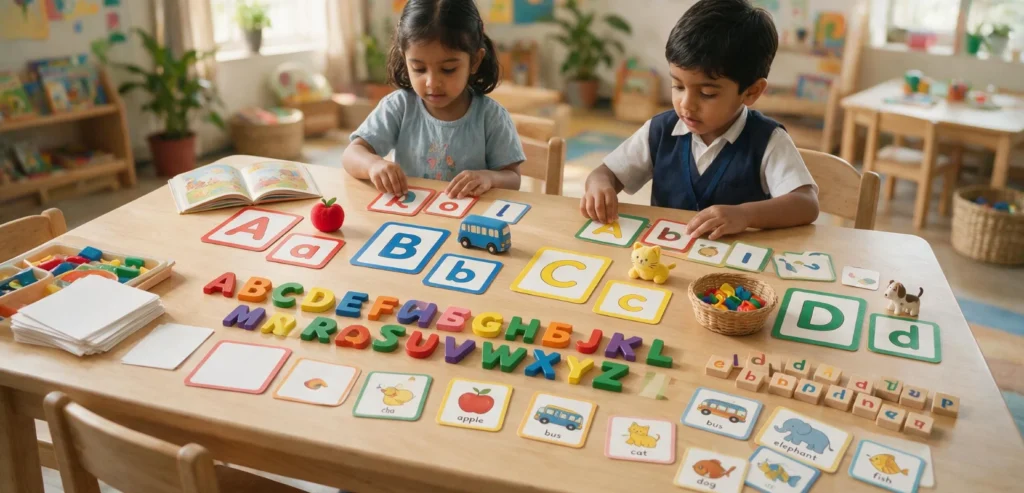
- A chart looks almost too simple to matter. It is doing more work than most people give it credit for.
- Letter recognition builds through repetition. Seeing the 26 shapes laid out the same way day after day sticks better than flashcards shuffled into random order.
- Vocabulary grows alongside the letters. Every keyword picture- apple, ball, cat, adds a word to a child’s vocabulary, not just a shape to memorize.
- Pointing and tracking matters more than people think. A child’s finger moving left to right across a chart is quietly practicing the eye movement that reading depends on later.
- It builds confidence before kindergarten. A kid who already knows most letters walks into that classroom with one less thing to catch up on.
Most children learn their capital letters before their lowercase ones. It’s not random. Capitals show up everywhere in a toddler’s world: cereal boxes, toy packaging, and their own name written on a cubby. A well-designed alphabet chart for kids shows both cases side by side, so lowercase doesn’t turn into a second, harder lesson down the road. You’ll see the same letter-sound-symbol approach echoed across early-literacy resources, including material published on The Little Scholar.
Types of Alphabet Charts (Uppercase, Lowercase & Picture Charts)
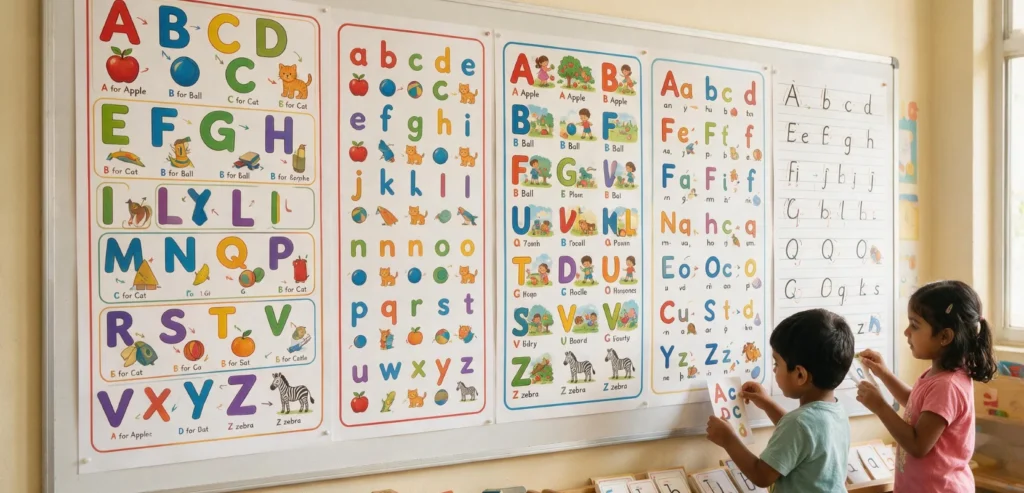
Not every chart is built the same, and the right one depends on where a child is and where the chart is going to hang.
| Chart Type | What It’s Good For |
| Uppercase-only chart | First introduction to letter shapes, bold and simple |
| Lowercase chart | Reading readiness, often paired next to the uppercase version |
| Picture and keyword chart | Vocabulary and sound association together |
| Phonics or sound anchor chart | Letters grouped by sound, sometimes aligned to structured programs like Orton-Gillingham |
| Handwriting or formation chart | Directional arrows showing stroke order for pre-writing practice |
A picture-based chart tends to cover the widest range, honestly, because it’s doing two jobs at once: letter recognition and vocabulary. For a classroom, pairing a bold uppercase chart near the door with a picture chart at the reading corner is one of the more practical alphabet chart ideas for preschool spaces. Same 26 letters, two different visual formats, no extra prep required.
Some charts go further. You’ll find versions with digraphs like ch, ll, and rr worked in, versions built around sign language hand shapes, and versions with a slanted, D’Nealian-style font for handwriting practice. None of these are better, exactly. They just serve different goals.
Best Age to Start Using an Alphabet Chart

There is no right age. What early educators agree upon is a general window, not a deadline. Toddlers are too young for a lesson and too young for exposure. A chart on the wall, at that stage, is scenery something toddlers glance at without really studying.
By preschool, most kids start noticing individual letters on their own, especially the ones in their name. This is usually the stage a chart is actually designed for. Naming letters, matching upper and lower case, and connecting a few to their sounds.
When a child reaches pre-K and kindergarten, the role of the chart changes in a way. The chart stops being about knowing letters. Instead, the chart starts to help with sounds and blending, which is how kids start to read. After that, when a child moves into early grade school, the chart stays around. The chart just becomes something to look at rather than a lesson to learn.
The real answer, which I always tell parents who ask me directly, is to start when the kid shows interest. Do not wait for a birthday. If a toddler points at a sign. Asks what a letter is, and that toddler is ready. A four-year-old who does not care about letters is not behind. The chart will just wait until curiosity shows up on its own. Comparing one child’s pace to another’s rarely helps anyone. Kids get there. Some just take the scenic route.
How to Use an Alphabet Chart for kids at Home
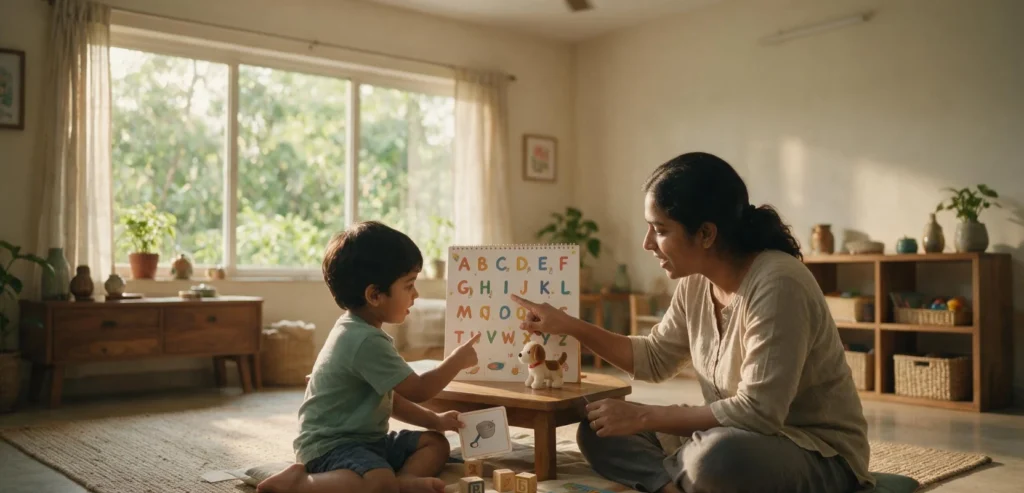
Owning a chart and actually using an alphabet chart are two very different things. A poster taped to a wall that nobody looks at is not teaching anyone anything.
Here is what I have found tends to work:
- Hang the alphabet chart where the child can actually see the alphabet chart. Put the alphabet chart at their eye level, not your eye level. An alphabet chart placed six feet up might as well not exist.
- Point to the letter. Say the letter and its keyword out loud. Do not quiz the child in the weeks. Just talk about the letters.
- Let the child’s own name lead the way if you want a starting point. Kids tend to notice the letters in their name first anyway.
- Keep the chart sessions short. Doing two or three minutes a day is much better than one long sitting that ends in a meltdown.
- Tie it to real life. If the chart says D for Dog and there’s a dog in the house, point that out on a walk, not just at the wall.
- Follow the child’s lead once they start pointing on their own. Skip the alphabetical order if they want to jump straight to their favorite letter.
- Switch the format now and then. An uppercase chart for one month, a picture chart the next, keeps it from fading into wallpaper.
It’s worth saying plainly: kids don’t just pick this up by osmosis. It takes a bit of modeling early on, pointing to the letter, saying its name, its keyword, and its sound before a child starts doing it unprompted. That’s not a flaw in the method. That’s just how it works.
So none of this needs a curriculum. The chart’s job is to sit there, patiently, until a child is ready. The parent’s job is mostly to narrate what’s already on the wall.
Also read: How to Improve Handwriting for Kids: Easy Tips for Better Writing
Tips to Teach Letter Sounds Using the Chart
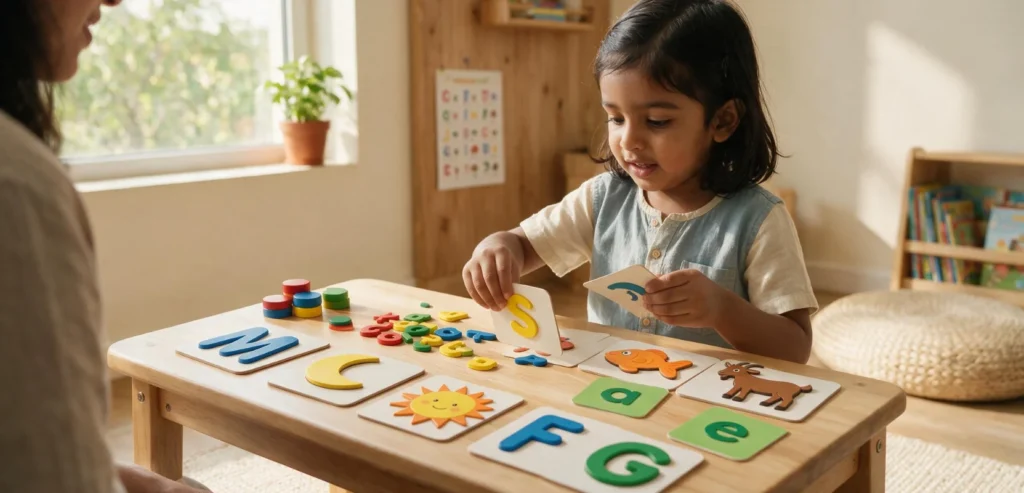
Letter names and letter sounds are two different skills. A chart can teach both. Just not at the same time.
- Separate the name from the sound at first. “This is B. B. says buh, like ball. ” Combine them too early and you’ll just confuse a kid who’s still working on either one.
- Start with sounds a child can physically stretch out. M, S, and F can be held, mmmm, sssss, ffff. That’s easier than a stop sound like B or D, which can’t be dragged out the same way.
- Let the picture do the heavy lifting, not the letter shape. A kid who forgets what G sounds like will remember faster from a picture of a goat than from the abstract letter on its own.
- Treat vowels differently. They don’t behave like consonants; one vowel can make several sounds, so grouping them separately, some charts even color them red, keeps things from getting muddled.
- Treat vowels differently. Vowels do not behave like consonants; a single vowel can make sounds, so putting them in a separate group helps keep everything clear. Vowels can sound a lot, so separating them keeps the learning simple.
- Turn it into a game when you can. Playing a game such as “I spy something that starts like a sun” does more than a drill ever will. Kids pay attention to games longer than lessons.
None of this is glamorous. It’s repetitive. It’s the same 26 letters, over and over, for months. But that repetition is exactly the mechanism that makes it stick.
FAQs
It is slower than you would think. One or two new letters each week are plenty for a toddler. Rushing through the chart in one sitting simply means that letters will not stick.
Uppercase, most of the time. The shapes of letters are simpler, with straighter lines and fewer curves, and uppercase letters show up more in daily life. Lowercase letters become easier once uppercase letters are solid.
Not really. A-to-Z isn’t magic. It just gives a child a consistent pattern to notice, which letters feel familiar and which ones still don’t.